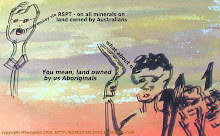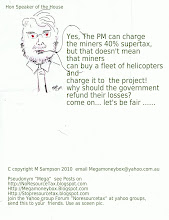
so the deal is: greens support the RSPT or maybe no second preferences from labor! or have we got it wong (ha ha joke)?
read below and beware. Mega's main reasons for opposing the RSPT is that
1. It is against the "fairness" of Australia. all companies and industries should be treated the same and are entitled to know that the amount of tax they have to pay is the same as other companies.
2. It will present a precedent for governments to then seek out other "high income" industries.
3 It is against the constitution re taxation. section 55 (i) and (ii). especially if WA and Qld are rewarded with a higher share of the revenues.
4. It has created an unnecessary division in Australia, rich against poor.
5. the RSPT tax will result in higher energy costs for Australians.The poor will pay.
below is an example of that division and how cleverly the Government has created a group to be hated.. Isn't that what Hitler did?
I'm sad to see that the greens are looking after their own political interest, in siding with and supporting labor, regarding this issue.
http://www.tradingroom.com.au/apps/view_breaking_news_article.ac?page=/data/news_research/published/2010/6/181/catf_100630_090100_3710.html
ERRA, June 30 AAP
June 30 2010, 09:01AM
Greens warn Labor on mining tax
The Australian Greens won't rule out dropping their support for Labor's proposed resource super-profits tax if the government caves in to pressure from mining companies.
But leader Bob Brown has stopped short of saying the minor party will try to block a modified tax plan in the Senate.
The government is keen to reach a settlement with the industry over the 40 per cent tax ahead of an election, to be held possibly as early as August.
The Greens would not look kindly on a "substantial cave-in against the public interest", Senator Brown said.
"Then we will be looking at that with a very jaundiced eye," he told ABC Radio on Wednesday.
The Greens are insisting any deal with industry maintains the $12 billion in revenue forecast in the budget's forward estimates.
Senator Brown said the mining companies were demonstrating brutal power by demanding the government meet their demands or risk a revival of the industry's advertising campaign against the tax.
"I am astonished as this very, very arrogant show of power from the mining corporations," he said.
Tuesday, June 29, 2010
Is this how it will pan out? divide and conquer?
So is this how it will pan out. the old Divide and conquer, with miners taking the best option. read article below from the business speculator, especially last para..
It won't really matter much if there is an early election.
The tax will lead to a constitutional challenge and should win. it is against section 55 (i) and (ii) plus possibly other sections. This government, if re-elected will try to impose it on other sectors...
Let's not give in now.
Julia's choice on RSPTStephen Bartholomeusz
Published 4:05 PM, 29 Jun 2010
--------------------------------------------------------------------------------
It would appear that we’ll soon know whether Julia Gillard was genuine when she said she wanted to negotiate with the mining industry over the proposed resource super profits tax, or whether she’s simply following the political strategy Kevin Rudd was pursuing before he was so abruptly dumped.
There are reports that Federal Cabinet is considering changes to the RSPT that would carve out the prospective coal seam gas-fed export LNG projects in Queensland, which would be covered by something akin to the existing petroleum resource rent tax. The RSPT could kill the projects and the planned tens-of-billions of investment in the new sector; under a PRRT they’d not pay a super tax on profits for probably the best part of a decade, if not more.
Changes to the super tax treatment of the CSG projects, or exclusion of low-value resources, or even smaller mines, would have minimal impact on the revenue collected from a RSPT, particularly if the government abandoned the tax credit for losses that no-one in the industry values or wants.
Therefore the government could appear to make very major concessions to the industry with minimal impact on the revenue the tax raises – indeed it might raise more than the $9 billion a year it is expected to generate without the transferable tax credit scheme.
Gillard could even raise the controversial uplift factor in the tax from the government bond rate of less than 6 per cent to the 11 per cent or so in the PRRT without making any real concession to the miners who will pay the overwhelming majority of the tax; the big mining houses with long-established mines and the iron ore and export-coal producers, in particular.
That would, however, be a highly political strategy – it was the strategy being developed by Kevin Rudd and Wayne Swan before Gillard displaced Rudd. It was designed to fragment the hitherto united industry opposition to the RSPT, isolating BHP Billiton, Rio Tinto, Xstrata and the other big miners and enabling the government to portray them as obdurate and greedy and absolutely committed to not paying a "fairer" share of tax.
The mining industry campaign would lose a lot of its potency if the industry’s solidarity was broken and it was being prosecuted only by a relative handful of the biggest players. A politically driven strategy would, however, also be a breach of Gillard’s promise to negotiate in good faith. The industry gave her the benefit of the doubt when it froze its campaign.
If she is genuine, and is genuinely concerned about the long-term best interests of the economy, rather than the short-term funding of Rudd and Swan’s planned pre-election spending spree – and the bigger miners appear to believe that she might be (while worrying about the influence of Swan and Treasury) – then the tax needs to be completely re-thought.
The headline rate of 40 per cent needs to be significantly reduced and the up-lift factor significantly increased and applied, not to the written-down book values of the mines, but to something approximating their current value to abandon the retrospectivity of the proposed tax. A re-thought tax also ought to discriminate between different types of resources and their different margin and capital expenditure profiles.
The Australian miners do compete in global markets and there is global competition for their capital. The long-term national interest dictates that any changes to the tax regime don’t undermine their competitiveness or divert capital to competing jurisdictions.
If Gillard includes the big miners in her negotiated responses to the exposed issues with the RSPT she will have demonstrated that she was being genuine when she identified the need to negotiate rather than consult with the industry as one of her earliest and most urgent priorities.
That might mean junking Swan’s budget strategy and the projected spending paid for by the tax; which won’t reflect well on Swan, but that’s a "price" worth paying to clear the way for a new tax on genuine super profits (rather than a super tax on normal profits) that doesn’t damage the sector and Australia’s reputation as a stable place for investment.
It won't really matter much if there is an early election.
The tax will lead to a constitutional challenge and should win. it is against section 55 (i) and (ii) plus possibly other sections. This government, if re-elected will try to impose it on other sectors...
Let's not give in now.
Julia's choice on RSPTStephen Bartholomeusz
Published 4:05 PM, 29 Jun 2010
--------------------------------------------------------------------------------
It would appear that we’ll soon know whether Julia Gillard was genuine when she said she wanted to negotiate with the mining industry over the proposed resource super profits tax, or whether she’s simply following the political strategy Kevin Rudd was pursuing before he was so abruptly dumped.
There are reports that Federal Cabinet is considering changes to the RSPT that would carve out the prospective coal seam gas-fed export LNG projects in Queensland, which would be covered by something akin to the existing petroleum resource rent tax. The RSPT could kill the projects and the planned tens-of-billions of investment in the new sector; under a PRRT they’d not pay a super tax on profits for probably the best part of a decade, if not more.
Changes to the super tax treatment of the CSG projects, or exclusion of low-value resources, or even smaller mines, would have minimal impact on the revenue collected from a RSPT, particularly if the government abandoned the tax credit for losses that no-one in the industry values or wants.
Therefore the government could appear to make very major concessions to the industry with minimal impact on the revenue the tax raises – indeed it might raise more than the $9 billion a year it is expected to generate without the transferable tax credit scheme.
Gillard could even raise the controversial uplift factor in the tax from the government bond rate of less than 6 per cent to the 11 per cent or so in the PRRT without making any real concession to the miners who will pay the overwhelming majority of the tax; the big mining houses with long-established mines and the iron ore and export-coal producers, in particular.
That would, however, be a highly political strategy – it was the strategy being developed by Kevin Rudd and Wayne Swan before Gillard displaced Rudd. It was designed to fragment the hitherto united industry opposition to the RSPT, isolating BHP Billiton, Rio Tinto, Xstrata and the other big miners and enabling the government to portray them as obdurate and greedy and absolutely committed to not paying a "fairer" share of tax.
The mining industry campaign would lose a lot of its potency if the industry’s solidarity was broken and it was being prosecuted only by a relative handful of the biggest players. A politically driven strategy would, however, also be a breach of Gillard’s promise to negotiate in good faith. The industry gave her the benefit of the doubt when it froze its campaign.
If she is genuine, and is genuinely concerned about the long-term best interests of the economy, rather than the short-term funding of Rudd and Swan’s planned pre-election spending spree – and the bigger miners appear to believe that she might be (while worrying about the influence of Swan and Treasury) – then the tax needs to be completely re-thought.
The headline rate of 40 per cent needs to be significantly reduced and the up-lift factor significantly increased and applied, not to the written-down book values of the mines, but to something approximating their current value to abandon the retrospectivity of the proposed tax. A re-thought tax also ought to discriminate between different types of resources and their different margin and capital expenditure profiles.
The Australian miners do compete in global markets and there is global competition for their capital. The long-term national interest dictates that any changes to the tax regime don’t undermine their competitiveness or divert capital to competing jurisdictions.
If Gillard includes the big miners in her negotiated responses to the exposed issues with the RSPT she will have demonstrated that she was being genuine when she identified the need to negotiate rather than consult with the industry as one of her earliest and most urgent priorities.
That might mean junking Swan’s budget strategy and the projected spending paid for by the tax; which won’t reflect well on Swan, but that’s a "price" worth paying to clear the way for a new tax on genuine super profits (rather than a super tax on normal profits) that doesn’t damage the sector and Australia’s reputation as a stable place for investment.

Friday, June 25, 2010
Don't cave in.. the election is nigh. RSPT must be abolished
Don't cave in, otherwise the RSPT will become a precedent for other industries. Tax laws need to be fair and the same for all companies / people. They can't be retrospective, and can't be dreamed up and implemented without scrutiny.
Time is on the side of the miners, as long as they don't let themselves be rushed into a deal. Wayne Swan and Julia Gillard have painted themselves into a corner, and wont give up. The electors will show their displeasure at the election to be held before the end of the year.
There's heaps of press articles, and here's one link worth following.
--------------------------------------------------------------------------------
Gillard must mop up Swan's messAlan Kohler
Published 7:47 AM, 25 Jun 2010 Last update 10:16 AM, 25 Jun 2010 reference
http://www.businessspectator.com.au/bs.nsf/Article/Minerals-Council-Julia-Gillard-RSPT-Kevin-Rudd-ren-pd20100625-6R4VY?OpenDocument&src=mp
--------------------------------------------------------------------------------
Treasurer Wayne Swan, architect of the stinker of a budget handed down in May, must now work quickly with Prime Minister Gillard to release a mini-budget that makes sense.
Time is on the side of the miners, as long as they don't let themselves be rushed into a deal. Wayne Swan and Julia Gillard have painted themselves into a corner, and wont give up. The electors will show their displeasure at the election to be held before the end of the year.
There's heaps of press articles, and here's one link worth following.
--------------------------------------------------------------------------------
Gillard must mop up Swan's messAlan Kohler
Published 7:47 AM, 25 Jun 2010 Last update 10:16 AM, 25 Jun 2010 reference
http://www.businessspectator.com.au/bs.nsf/Article/Minerals-Council-Julia-Gillard-RSPT-Kevin-Rudd-ren-pd20100625-6R4VY?OpenDocument&src=mp
--------------------------------------------------------------------------------
Treasurer Wayne Swan, architect of the stinker of a budget handed down in May, must now work quickly with Prime Minister Gillard to release a mini-budget that makes sense.
Wednesday, June 23, 2010
twiggy didnt cave in.. and Gillard gets top job.
J Gillard announced as PM,this morning at 9.30
The woman with tuck shops the size of cubby houses as her monument.
Don't expect any change, but maybe a quick election announcement..
Here's the lastest about twiggy. Good to see he didn't give in...
http://www.businessspectator.com.au/bs.nsf/Article/Fortescue-not-swayed-by-govt-RSPT-offer-report-pd20100624-6PRK9?opendocument&src=rss
Fortescue not swayed by govt RSPT offer: report
QUICK SUMMARY | FULL STORY | RSPT | COMMENT
Iron ore miner Fortescue Metals Group Ltd has refused to be swayed by federal government attempts to entice the company to support the proposed 40 per cent resources super profits tax (RSPT), The Australian reports.
It is believed that Fortescue chief executive Andrew Forrest is not satisfied with the government's suggestion that the treatment of capital could be altered to help the company with large-scale borrowing to fund expansion.
The company is understood to have told Treasury officials that any such changes would merely be a short-term fix to suit one company, and would not solve the broader, long-term problems the mining industry sees with the tax, the newspaper said.
Mr Forrest has been a vocal opponent of the RSPT, and the government's suggestion is believed to be part of a concerted effort to break up the united wall of resistance from resource sector heavies.
Canberra's attempt to sway Fortescue highlights the ongoing struggle the government has had making any in-roads with persuading industry giants BHP Billiton Ltd, Rio Tinto Ltd and Xstrata to come on board.
Yesterday, Prime Minister Kevin Rudd urged mining companies not yet engaged in negotiations with the government over the resource super profits tax to do so now.
The woman with tuck shops the size of cubby houses as her monument.
Don't expect any change, but maybe a quick election announcement..
Here's the lastest about twiggy. Good to see he didn't give in...
http://www.businessspectator.com.au/bs.nsf/Article/Fortescue-not-swayed-by-govt-RSPT-offer-report-pd20100624-6PRK9?opendocument&src=rss
Fortescue not swayed by govt RSPT offer: report
QUICK SUMMARY | FULL STORY | RSPT | COMMENT
Iron ore miner Fortescue Metals Group Ltd has refused to be swayed by federal government attempts to entice the company to support the proposed 40 per cent resources super profits tax (RSPT), The Australian reports.
It is believed that Fortescue chief executive Andrew Forrest is not satisfied with the government's suggestion that the treatment of capital could be altered to help the company with large-scale borrowing to fund expansion.
The company is understood to have told Treasury officials that any such changes would merely be a short-term fix to suit one company, and would not solve the broader, long-term problems the mining industry sees with the tax, the newspaper said.
Mr Forrest has been a vocal opponent of the RSPT, and the government's suggestion is believed to be part of a concerted effort to break up the united wall of resistance from resource sector heavies.
Canberra's attempt to sway Fortescue highlights the ongoing struggle the government has had making any in-roads with persuading industry giants BHP Billiton Ltd, Rio Tinto Ltd and Xstrata to come on board.
Yesterday, Prime Minister Kevin Rudd urged mining companies not yet engaged in negotiations with the government over the resource super profits tax to do so now.
Monday, June 21, 2010
so is this the answer??
Latest Commentary
from "the business speculator"
China's RSPT bounty
STEPHEN BARTHOLOMEUSZ The Rudd government's resource super profits tax will force miners to ask China's state-owned financiers for cash, bringing in more Chinese state-owned enterprises as shareholders. 4:13 PM read more
http://www.businessspectator.com.au/bs.nsf/Article/Bartholomeusz-RSPT-iron-ore-China-Development-Bank-pd20100621-6M8YT?OpenDocument&src=pmm
Commentary
4:13 PM, 21 Jun 2010
| More
Stephen Bartholomeusz
China's RSPT bounty
Kevin Rudd might want to characterise the $10 billion or so of deals with China unveiled today during the visit of Chinese vice-president Xi Jinping as evidence that the resource super profits tax is not affecting investment, but then the Chinese are not your ordinary investors.
And, indeed, given that China Development Bank (CDB) features in several of the resource deals signed today, the deals themselves aren’t necessarily conventional resource sector investments.
The Chinese might be a little annoyed that the RSPT was announced after their state-owned enterprises had invested tens of billions of dollars in the Australian resource sector but (a) their deals are likely to be the least affected by the RSPT (with a couple of exceptions) and (b) they aren’t necessarily as fixated with profitability as Australian miners.
It needs to be remembered that the Rudd government has hailed the tax – which would be paid largely by the big miners on well-established low-cost and highly profitable mines – as helping to promote hitherto marginal production within the sector. Its initial impact is positive for new and high-cost/low quality mines.
China is unlikely to be fussed if the big iron ore and metallurgical coal producers are less competitive, relative to their international peers, as a result of the tax, given the paranoia of its big steel producers about the level of influence and market power the producers have over key inputs into China’s industrial activity.
Conversely, it is in China’s own long-term interests to encourage new sources of iron ore and coal and other commodities to increase supply, temper price rises and counter the influence of the global resource groups.
Indeed, much of China’s activity in Australia in the past has been focused on the emerging iron ore producers like Fortescue and the Mid West iron ore province, which could be classified as marginal producers.
The memorandums of understanding China Development Bank has signed with Aquila Resources and Karara Mining – they both have West Australian iron ore projects in which there are pre-existing Chinese partners – fit the kind of strategy that is more interested in security of supply, increased supply and wider available sources of supply than in its absolute profitability.
Helping to finance the Oakajee port and rail infrastructure that helps open up the Mid West is a relatively obvious way for CDB to facilitate China’s strategic interests.
There is, potentially, enormous mutual interest in partnering with the Chinese to bring new projects and resource provinces into production.
That, however, doesn’t validate the proposed tax, which would amplify the strategic benefits the Chinese are seeking by slowing expansion of the production of our most efficient iron ore and coal producers – the ones able to use their market position to maximise the value received from exploiting those resources.
The other issue raised by the tax, and one that Fortescue’s Andrew Forrest has been particularly critical of, is that it will effectively destroy conventional project financing because the RSPT applies before financing costs.
To obtain project funding, smaller producers – who traditionally have used project financing to develop their mines – will have to turn to financiers more interested in gaining access to supply than in the security of their loans.
That almost inevitably means bringing in Chinese state-owned enterprises as shareholders and asking the Chinese state-owned financiers for help with the debt component. The impact of the RSPT would dictate that miners looked to financiers less interested in profitability than conventional capital providers.
One suspects that Rudd and Wayne Swan – both very sensitive to the politics of Chinese investment in the past – haven’t properly thought through the implications for Chinese interest in Australian resources of a RSPT that encourages marginal production during a boom, discourages conventional financing and commits the taxpayer to underwriting 40 per cent of the losses in a downturn.
from "the business speculator"
China's RSPT bounty
STEPHEN BARTHOLOMEUSZ The Rudd government's resource super profits tax will force miners to ask China's state-owned financiers for cash, bringing in more Chinese state-owned enterprises as shareholders. 4:13 PM read more
http://www.businessspectator.com.au/bs.nsf/Article/Bartholomeusz-RSPT-iron-ore-China-Development-Bank-pd20100621-6M8YT?OpenDocument&src=pmm
Commentary
4:13 PM, 21 Jun 2010
| More
Stephen Bartholomeusz
China's RSPT bounty
Kevin Rudd might want to characterise the $10 billion or so of deals with China unveiled today during the visit of Chinese vice-president Xi Jinping as evidence that the resource super profits tax is not affecting investment, but then the Chinese are not your ordinary investors.
And, indeed, given that China Development Bank (CDB) features in several of the resource deals signed today, the deals themselves aren’t necessarily conventional resource sector investments.
The Chinese might be a little annoyed that the RSPT was announced after their state-owned enterprises had invested tens of billions of dollars in the Australian resource sector but (a) their deals are likely to be the least affected by the RSPT (with a couple of exceptions) and (b) they aren’t necessarily as fixated with profitability as Australian miners.
It needs to be remembered that the Rudd government has hailed the tax – which would be paid largely by the big miners on well-established low-cost and highly profitable mines – as helping to promote hitherto marginal production within the sector. Its initial impact is positive for new and high-cost/low quality mines.
China is unlikely to be fussed if the big iron ore and metallurgical coal producers are less competitive, relative to their international peers, as a result of the tax, given the paranoia of its big steel producers about the level of influence and market power the producers have over key inputs into China’s industrial activity.
Conversely, it is in China’s own long-term interests to encourage new sources of iron ore and coal and other commodities to increase supply, temper price rises and counter the influence of the global resource groups.
Indeed, much of China’s activity in Australia in the past has been focused on the emerging iron ore producers like Fortescue and the Mid West iron ore province, which could be classified as marginal producers.
The memorandums of understanding China Development Bank has signed with Aquila Resources and Karara Mining – they both have West Australian iron ore projects in which there are pre-existing Chinese partners – fit the kind of strategy that is more interested in security of supply, increased supply and wider available sources of supply than in its absolute profitability.
Helping to finance the Oakajee port and rail infrastructure that helps open up the Mid West is a relatively obvious way for CDB to facilitate China’s strategic interests.
There is, potentially, enormous mutual interest in partnering with the Chinese to bring new projects and resource provinces into production.
That, however, doesn’t validate the proposed tax, which would amplify the strategic benefits the Chinese are seeking by slowing expansion of the production of our most efficient iron ore and coal producers – the ones able to use their market position to maximise the value received from exploiting those resources.
The other issue raised by the tax, and one that Fortescue’s Andrew Forrest has been particularly critical of, is that it will effectively destroy conventional project financing because the RSPT applies before financing costs.
To obtain project funding, smaller producers – who traditionally have used project financing to develop their mines – will have to turn to financiers more interested in gaining access to supply than in the security of their loans.
That almost inevitably means bringing in Chinese state-owned enterprises as shareholders and asking the Chinese state-owned financiers for help with the debt component. The impact of the RSPT would dictate that miners looked to financiers less interested in profitability than conventional capital providers.
One suspects that Rudd and Wayne Swan – both very sensitive to the politics of Chinese investment in the past – haven’t properly thought through the implications for Chinese interest in Australian resources of a RSPT that encourages marginal production during a boom, discourages conventional financing and commits the taxpayer to underwriting 40 per cent of the losses in a downturn.
australia -chinese deal announced today?!?
What will this mean to the miners RSPT? no wonder the Government wanted to get its hand on some of this money...
so who owns Australia now?
announcement:
China to invest billions in Australian energy, resource deals
* From: AAP
* June 21, 2010 12:59PM
CHINESE companies will build mines, railways and port facilities in Australia under a series of billion-dollar resources deals signed in Canberra.
Chinese Vice-President Xi Jinpeng inked the deals in meetings with Prime Minister Kevin Rudd.
China is Australia's largest trading partner, and its thirst for iron ore and natural gas helped keep Australia out of the global recession.
Mr Rudd said the 10 deals focused on resources and energy.
"This demonstrates the dynamic relations between the two countries in this sector, and the strong complementarity of the two economies," he said.
Under one deal, Chinese companies will help fund a $US8 billion ($9.1 billion) coal mine, railway and coal-loading terminal near Bowen in Queensland.
Mr Rudd said that deal would yield $4 billion in exports each year for 25 years.
Another deal commits Chinese experts and engineers to work on the expansion of Fortescue's iron ore projects in the Pilbara region of Western Australia, which Mr Rudd says will be worth $5 billion a year in exports.
Fortescue boss Andrew "Twiggy" Forrest is a vocal opponent of the Government's proposed new mining tax.
China Development Bank will provide $US1.2 billion for a joint venture to build a new port and rail facilities at Oakajee in Western Australia, and invest in Aquila's coal and iron ore projects in the Pilbara.
Not all of the deals involve resources.
A new quarantine arrangement will allow for Tasmanian apples to be exported to China, while other deals aim at cooperation in education and telecommunications.
so who owns Australia now?
announcement:
China to invest billions in Australian energy, resource deals
* From: AAP
* June 21, 2010 12:59PM
CHINESE companies will build mines, railways and port facilities in Australia under a series of billion-dollar resources deals signed in Canberra.
Chinese Vice-President Xi Jinpeng inked the deals in meetings with Prime Minister Kevin Rudd.
China is Australia's largest trading partner, and its thirst for iron ore and natural gas helped keep Australia out of the global recession.
Mr Rudd said the 10 deals focused on resources and energy.
"This demonstrates the dynamic relations between the two countries in this sector, and the strong complementarity of the two economies," he said.
Under one deal, Chinese companies will help fund a $US8 billion ($9.1 billion) coal mine, railway and coal-loading terminal near Bowen in Queensland.
Mr Rudd said that deal would yield $4 billion in exports each year for 25 years.
Another deal commits Chinese experts and engineers to work on the expansion of Fortescue's iron ore projects in the Pilbara region of Western Australia, which Mr Rudd says will be worth $5 billion a year in exports.
Fortescue boss Andrew "Twiggy" Forrest is a vocal opponent of the Government's proposed new mining tax.
China Development Bank will provide $US1.2 billion for a joint venture to build a new port and rail facilities at Oakajee in Western Australia, and invest in Aquila's coal and iron ore projects in the Pilbara.
Not all of the deals involve resources.
A new quarantine arrangement will allow for Tasmanian apples to be exported to China, while other deals aim at cooperation in education and telecommunications.
What does twiggy know taht we don't?
What does twiggy ASX:FMG know that we don't?
is there a back room deal here?
we need to see it all on the table asap.
http://m.foxbusiness.com/quickPage.html?page=19453&content=39788027
Fortescue Metals CEO: Proposed Mining Tax Can't Be Justified
Jun 21, 2010 12:50 AM EDT
CANBERRA -(Dow Jones)- Fortescue Metals Group Ltd. (FMG.AU) Chief Executive Andrew Forrest said Monday the government's proposed resource super profits tax was "now officially dead," it can't be economically justified and is harming Australia's economy daily.
If the tax proposal proceeds it won't look anything like the "dreadful economy-smashing" tax that was put forward in early May, he told reporters.
Asked about comments by Treasury Secretary Ken Henry that negotiations about the tax would take months, Forrest said he "wouldn't have thought
is there a back room deal here?
we need to see it all on the table asap.
http://m.foxbusiness.com/quickPage.html?page=19453&content=39788027
Fortescue Metals CEO: Proposed Mining Tax Can't Be Justified
Jun 21, 2010 12:50 AM EDT
CANBERRA -(Dow Jones)- Fortescue Metals Group Ltd. (FMG.AU) Chief Executive Andrew Forrest said Monday the government's proposed resource super profits tax was "now officially dead," it can't be economically justified and is harming Australia's economy daily.
If the tax proposal proceeds it won't look anything like the "dreadful economy-smashing" tax that was put forward in early May, he told reporters.
Asked about comments by Treasury Secretary Ken Henry that negotiations about the tax would take months, Forrest said he "wouldn't have thought
Subscribe to:
Posts (Atom)