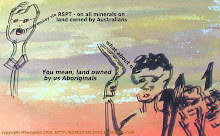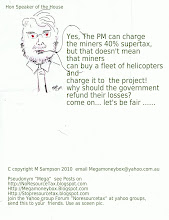
GOOD ON YA ANDREW..kEEP IT UP.
What I would have encouraged him to say, was to quote the applicable section of the constitution.
We Quoted this in an early post. There will be argument whether royalties are a tax, and issues relating to what the governement eventually introduces. Here's the transcript below.
http://www.abc.net.au/7.30/content/2011/s3243809.htm?
Australian Broadcasting Corporation
Broadcast: 14/06/2011
Reporter: Chris Uhlmann
The mining magnate speaks with 7.30's Chris Uhlmann about a possible High Court challenge to the Government's mining tax.
Transcript
LEIGH SALES, PRESENTER: A touch under a year ago Julia Gillard said she'd sort three things before calling an election: border protection; climate change; and the mining tax.
Two of those have been daily ordeals ever since, but the government insists the mining tax is settled.
But one high profile miner is threatening a high court challenge over the tax.
The CEO of Fortescue Metals Groups, Andrew Forrest, was in Canberra today for meetings with the Government, Opposition and Independents.
He also spoke with 7.30's political editor, Chris Uhlmann.
CHRIS UHLMANN, REPORTER: Andrew Forrest, welcome.
ANDREW FORREST, FORTESCUE CEO: Thank you very much.
CHRIS UHLMANN: Will you take the Federal Government to the High Court over its mining tax?
ANDREW FORREST: If it's unconstitutional, if it's unfair, if it discriminates against Australian companies and favours multinationals, I think, on behalf of so many other companies, and really, all Australians, that's a precedent too dangerous not to challenge.
CHRIS UHLMANN: You must have tested that with your lawyers, what are the answers to those questions?
ANDREW FORREST: At this stage it looks highly unconstitutional, but clearly Canberra has different lawyers.
CHRIS UHLMANN: On what grounds though, because it's not unfair if it's just being better for one company than another?
ANDREW FORREST: Certainly. But if it discriminates against the States, if a State is taxed more heavily against another State, then that goes straight against the Constitution. Western Australia recently, as is of course their right, increased their royalties, we immediately have discrimination now.
CHRIS UHLMANN: Why didn’t you complain about that?
ANDREW FORREST: Well simply because it's their sovereign right. They own the metals in the grounds, we don't, it's been under the Constitution, owned by the people of the State. So they have every right to put it up.
But further, schools, hospitals, police, etc, are getting paid. We're not funding a great big dinosaur called the NBN (National Broadband Network), where we're going to waste a good $30 billion.
CHRIS UHLMANN: But that really has nothing to do with it, the Federal Government, does have a right to raise taxes, it raises company taxes, against you for example, so it can raise another tax ...
ANDREW FORREST: And it can do it again, and I'll happily pay it. And I'll happily pay this tax as well, no problem, provided of course that it doesn't let multinationals off and just penalise Australians.
CHRIS UHLMANN: Is it penalising Australians, or is it just penalising you because you have a different business model, which is built more on debt?
ANDREW FORREST: No, no, no, no, it, the great big companies have a huge, hundreds of billions of dollars between them, depreciation advantage, which means they can depreciate their assets by hundreds of billions of dollars before they pay this tax. No-one else has that, because they have that huge market value. It directly hits Australian developers.
CHRIS UHLMANN: If this tax is so bad, why has your share price gone up 80 per cent since it was announced?
ANDREW FORREST: I think you can put that down to the fact that we believed in the iron ore industry, we've continued to invest heavily, because we were told the Argus Review would be proper consultation, and that fundamental flaws, like an unfair tax which discriminates against Australians, would be taken into account.
That hasn't happened, that consultation was a farce.
CHRIS UHLMANN: But the people who buy your shares clearly see that there's going to be value in them in the future and they are going up, not down.
ANDREW FORREST: Well we would hope so, because without the multiplier effect of the mining industry the Australian economy would sadly be in a recession. It's the only industry which has a multiplier effect which is positive.
CHRIS UHLMANN: Because commodity prices are continuing to climb, and doesn't the Australian Government have a right, on behalf of the Australian people, to try and get as much of the profits as it can?
ANDREW FORREST: Well unfortunately commodity prices have been falling, I think, which is, you know...
CHRIS UHLMANN: Historically they are at enormous highs.
ANDREW FORREST: Commodity prices go up and down. Commodity prices right now are high on average, but they have fallen a good 25 per cent. That's a solid fall.
You can't put into a budget and budget out predictable cashflows on a tax where it goes up and down like a madman. It's just not a responsible tax to try and plug a budget hole with.
CHRIS UHLMANN: We're seeing 140 year Terms of Trade surge; doesn't the Australian Government have a right, on behalf of the Australian people, to try and cash in on that?
ANDREW FORREST: I think they have every right to. But why would they let off the multinationals and penalise Australians.
Let's get to the issue ...
CHRIS UHLMANN: They're not though, they're saying they can pay more tax, and surely you can pay more tax?
ANDREW FORREST: No, no. Why I'm protesting against this tax, and you heard me say it again, I'm happy to pay this tax, on the record, but, not if they let off the multinationals.
Why were the multinationals the only ones in the room? Why were only they protected from this tax? Why was this trick put into this tax? This pup sold to the Australian Government and they're now trying to sell it to the Australian people, the Australian people are going to see through that. It lets off the multinationals who were funding the advertising campaign against the Gillard Government, it let them off, they stopped that campaign. Now, they're penalising those who are the Australian developers.
CHRIS UHLMANN: But you agree, at the end of the day, those companies will be paying more tax?
ANDREW FORREST: They will pay a lot less profits, a lot less tax ...
CHRIS UHLMANN: But they'll pay more tax.
ANDREW FORREST: ... per dollar profit than what the Australian developer will, and I think that's terribly important. If they pay one cent more, as a multinational, and we pay $10 more, do you think that's fair?
This tax is without precedent, it's dangerous.
CHRIS UHLMANN: But that's not the order of magnitude we're talking about though is it?
ANDREW FORREST: But we are, we are. They have hundreds of billions of dollars, and I'm really glad you're zoning in on this.
Our view is, our fellow Australians have been sold a pup by this Government, they've given multinationals, who were funding the campaign against Gillard and Rudd, a huge tax break. But those who weren't, they're penalising. They're penalising Australians as opposed to multinationals.
CHRIS UHLMANN: Just to clarify this then, you're saying you're not against the tax, you're against the fact that you believe it gives a competitor a break?
ANDREW FORREST: What it does. It is so obvious, I'm surprised Ferguson, Gillard and Swan can't see it like the nose on their face. All I can assume is that they do, but because those three are so powerful they can advertise against the Government, they have let them off and they're penalising everyone else badly.
It is a tax which is designed by those three to limit badly their competition. Their competition is the Australian home-grown companies. That a Government could fall for that is unbelievable.
CHRIS UHLMANN: Are all your shareholders Australian home-grown?
ANDREW FORREST: Many are, and many aren't ...
CHRIS UHLMANN: And many aren't.
ANDREW FORREST: ...but we have 55,000 shareholders, of which 54,900 are Aussies.
CHRIS UHLMANN: Alright, but from the Australian Government's point of view can't you understand that in the end they are going to get more tax dollars out of those companies, and they're going to get more tax dollars out of you, at a time when commodity prices are high; that's a reasonable thing for them to do?
ANDREW FORREST: Absolutely. And let's do, and let's do it fairly. Let's have the great country of Australia levy taxes wherever it pleases.
But not introduce, the first time in Australia's federation history, a tax which really discriminates against Australians and helps multinationals who were funding a campaign against the Government. And the Government needed to look clever, very quickly, after the Prime Minister rolled the Foreign Minister. She needed to look very clever very quickly, so she announced a solution, which could only have been cooked up in a prior agreement, which was just to say 'give us a huge tax break and we'll support a new tax.'
CHRIS UHLMANN: Andrew Forrest, thank you.
ANDREW FORREST: Thank you very much.
Tuesday, June 14, 2011
Sunday, January 2, 2011
is Gillard having another go at the MRRT?
here's part of a comment on this ref page...
"steelerudd of coolie Posted at 12:47 PM Today
Angela Evans of Brisbane Posted at 11:59 AM Today Couple of points. The GST arrangements are a Commonwealth tax and a simple agreement to distribute the proceeds to the states according to the HFE relativities. The states have no right to the revenue - it is a gift from the Commonwealth which the Commonwealth can alter by simply changing the intergovernmental agreement and the GST tax legislation. No ifs, buts or maybes - Barnett is completely wrong and will lose his 30% once the legislation is passed and Gillard tires of his grandstanding. Wrong on so many points that I can,t even be bothered to point out your non factual parts , as for Joolya / Swan getting any thing past their master (B.Brown ) I,d Like To See That. MS So that's how they will get around the constitutional challenge? its a gift not a right?
here's the article
A NEW battle over the mineral resources rent tax is looming as Western Australia and Queensland push for the regional infrastructure fund promised as a sweetener to be excluded from the system for carving up more than $50 billion in GST receipts.
West Australian bureaucrats fear the state will be short-changed and have insisted the fund be quarantined from the Commonwealth Grants Commission process that siphons GST and other revenue from the rich states to the poorer ones.
The Queensland Labor government also insists that its share of the new fund must not be reduced because of the GST formula.
When Wayne Swan announced the Regional Infrastructure Fund -- to be funded with the proceeds of the then resource super-profits tax -- he said the "lion's share" should go to the mining states of WA and Queensland to fund rail, roads, ports and other crucial infrastructure.
But putting the cash -- an initial $700 million and up to $6bn over the next decade -- into the grants commission process for allocating the GST pool could reduce the amount received by WA and Queensland in favour of poorer states such as South Australia and Tasmania.
Start of sidebar. Skip to end of sidebar.
Related Coverage
EDITORIAL: Tax reform must head the agenda
End of sidebar. Return to start of sidebar.
The push threatens to add to the row between the Gillard government and the states over the MRRT, which replaced the RSPT in July. Canberra is already threatening to penalise states that increase their mining royalties in the future after a damaging stoush over whether miners would get a credit against federal taxes for hikes in state royalties.
West Australian Premier Colin Barnett said he remained vehemently opposed to the MRRT and the Regional Infrastructure Fund "doesn't win over our support for it at all".
"Julia Gillard keeps on talking about $2bn for Western Australia. I think it's over 10 years. It's not a large amount of money. You're talking about $200m a year. That won't build much."
While the Premier is focused on scuttling the MRRT, the WA Department of Treasury and Finance has pushed for the money to be quarantined from the grants commission process. It has outlined its position in a paper handed to a Senate committee inquiring into the mining tax.
Because the grants commission's formula for distributing the GST works by redistributing revenue windfalls -- including some federal payments -- between the states, the mining states stand to be punished if the infrastructure fund is not excluded from that process.
Queensland's Treasurer, Andrew Fraser, said it was crucial to ensure that his state was "not short-changed" because of "any unintended consequence" of the grants commission formula.
"We believe the federal government will honour its commitment to ensure the states that contribute to the mining boom get the lion's share of the infrastructure funds," Mr Fraser said. "This fund has been dedicated to meeting the infrastructure task in mining states and we won't accept moves by other states to claw back the funds."
WA is already refusing to hand over a third of the state's GST as part of the federal health takeover and new Victorian Premier, Ted Baillieu, has also threatened to resist the deal. Mr Barnett said the commonwealth could not "unilaterally, or even with majority state support, change the GST formulas".
As well as inflaming federal-state tensions, the stance being taken by the resource-rich states over the treatment of the infrastructure fund is reviving bickering between the states over the GST carve-up.
NSW Treasurer Eric Roozendaal hit back at WA and Queensland, accusing them of acting like the "Bonnie and Clyde of the Australian federation". "Enough is enough. It is time that the developing economies of Western Australia and Queensland were held to account for squandering the resources boom," he said.
While there was a strong case to help small states like the Northern Territory that needed to provide services to isolated Aboriginal communities, NSW had cross-subsidised WA and Queensland to the tune of $1bn over the past 10 years, he said.
But Mr Fraser said the non-mining states already reaped a "huge benefit" from royalties redistributed by the grants commission. While Canberra and the states agreed to the process for distributing GST in an inter-governmental agreement, the commonwealth has the scope to decide matters like quarantining of payments.
The government has not yet provided the terms of reference to the grants commission for its 2011 review of the distribution of GST money. Mr Swan's office said the government would work with the states and territories on the arrangements for the distribution of the Regional Infrastructure Fund. If federal payments are not specifically quarantined from the GST carve-up by the commonwealth, the grants commission typically decides whether they should be included. For example, if the money is paid to a third party and it has no impact on a state's budgetary capacity, it could decide to exclude it.
ref http://www.theaustralian.com.au/national-affairs/states-flag-new-mining-tax-row/story-fn59niix-1225980692715?referrer=email&source=Punch_nl&emcmp=Punch&emchn=Newsletter&emlist=Member
ref article http://www.theaustralian.com.au/national-affairs/states-flag-new-mining-tax-row/story-fn59niix-1225980692715?referrer=email&source=Punch_nl&emcmp=Punch&emchn=Newsletter&emlist=Member
"steelerudd of coolie Posted at 12:47 PM Today
Angela Evans of Brisbane Posted at 11:59 AM Today Couple of points. The GST arrangements are a Commonwealth tax and a simple agreement to distribute the proceeds to the states according to the HFE relativities. The states have no right to the revenue - it is a gift from the Commonwealth which the Commonwealth can alter by simply changing the intergovernmental agreement and the GST tax legislation. No ifs, buts or maybes - Barnett is completely wrong and will lose his 30% once the legislation is passed and Gillard tires of his grandstanding. Wrong on so many points that I can,t even be bothered to point out your non factual parts , as for Joolya / Swan getting any thing past their master (B.Brown ) I,d Like To See That. MS So that's how they will get around the constitutional challenge? its a gift not a right?
here's the article
A NEW battle over the mineral resources rent tax is looming as Western Australia and Queensland push for the regional infrastructure fund promised as a sweetener to be excluded from the system for carving up more than $50 billion in GST receipts.
West Australian bureaucrats fear the state will be short-changed and have insisted the fund be quarantined from the Commonwealth Grants Commission process that siphons GST and other revenue from the rich states to the poorer ones.
The Queensland Labor government also insists that its share of the new fund must not be reduced because of the GST formula.
When Wayne Swan announced the Regional Infrastructure Fund -- to be funded with the proceeds of the then resource super-profits tax -- he said the "lion's share" should go to the mining states of WA and Queensland to fund rail, roads, ports and other crucial infrastructure.
But putting the cash -- an initial $700 million and up to $6bn over the next decade -- into the grants commission process for allocating the GST pool could reduce the amount received by WA and Queensland in favour of poorer states such as South Australia and Tasmania.
Start of sidebar. Skip to end of sidebar.
Related Coverage
EDITORIAL: Tax reform must head the agenda
End of sidebar. Return to start of sidebar.
The push threatens to add to the row between the Gillard government and the states over the MRRT, which replaced the RSPT in July. Canberra is already threatening to penalise states that increase their mining royalties in the future after a damaging stoush over whether miners would get a credit against federal taxes for hikes in state royalties.
West Australian Premier Colin Barnett said he remained vehemently opposed to the MRRT and the Regional Infrastructure Fund "doesn't win over our support for it at all".
"Julia Gillard keeps on talking about $2bn for Western Australia. I think it's over 10 years. It's not a large amount of money. You're talking about $200m a year. That won't build much."
While the Premier is focused on scuttling the MRRT, the WA Department of Treasury and Finance has pushed for the money to be quarantined from the grants commission process. It has outlined its position in a paper handed to a Senate committee inquiring into the mining tax.
Because the grants commission's formula for distributing the GST works by redistributing revenue windfalls -- including some federal payments -- between the states, the mining states stand to be punished if the infrastructure fund is not excluded from that process.
Queensland's Treasurer, Andrew Fraser, said it was crucial to ensure that his state was "not short-changed" because of "any unintended consequence" of the grants commission formula.
"We believe the federal government will honour its commitment to ensure the states that contribute to the mining boom get the lion's share of the infrastructure funds," Mr Fraser said. "This fund has been dedicated to meeting the infrastructure task in mining states and we won't accept moves by other states to claw back the funds."
WA is already refusing to hand over a third of the state's GST as part of the federal health takeover and new Victorian Premier, Ted Baillieu, has also threatened to resist the deal. Mr Barnett said the commonwealth could not "unilaterally, or even with majority state support, change the GST formulas".
As well as inflaming federal-state tensions, the stance being taken by the resource-rich states over the treatment of the infrastructure fund is reviving bickering between the states over the GST carve-up.
NSW Treasurer Eric Roozendaal hit back at WA and Queensland, accusing them of acting like the "Bonnie and Clyde of the Australian federation". "Enough is enough. It is time that the developing economies of Western Australia and Queensland were held to account for squandering the resources boom," he said.
While there was a strong case to help small states like the Northern Territory that needed to provide services to isolated Aboriginal communities, NSW had cross-subsidised WA and Queensland to the tune of $1bn over the past 10 years, he said.
But Mr Fraser said the non-mining states already reaped a "huge benefit" from royalties redistributed by the grants commission. While Canberra and the states agreed to the process for distributing GST in an inter-governmental agreement, the commonwealth has the scope to decide matters like quarantining of payments.
The government has not yet provided the terms of reference to the grants commission for its 2011 review of the distribution of GST money. Mr Swan's office said the government would work with the states and territories on the arrangements for the distribution of the Regional Infrastructure Fund. If federal payments are not specifically quarantined from the GST carve-up by the commonwealth, the grants commission typically decides whether they should be included. For example, if the money is paid to a third party and it has no impact on a state's budgetary capacity, it could decide to exclude it.
ref http://www.theaustralian.com.au/national-affairs/states-flag-new-mining-tax-row/story-fn59niix-1225980692715?referrer=email&source=Punch_nl&emcmp=Punch&emchn=Newsletter&emlist=Member
ref article http://www.theaustralian.com.au/national-affairs/states-flag-new-mining-tax-row/story-fn59niix-1225980692715?referrer=email&source=Punch_nl&emcmp=Punch&emchn=Newsletter&emlist=Member

Sunday, December 12, 2010
There won't be a mining tax because this governement will be gone.....because
Hi to all comfy voters.
Julian Assange (Wikileaks Publisher of leaked govt documents) has already
been on posters with a likeness to Che Guevara, the cuban
revolutionary/terrorist depending on your viewpoint, the one well known in the black beret.
Julian and wikileaks will be seen as freedom fighters and matyrs.(freedom
of the press and anti usa sentiment) the article below about Bob Brown and Julia Gillard puts it so succinctly. When USA senators call for him to be executed, we know we have lost all pretense of justice and fairness, and Aussie independence.
This will prove to be the case of this century. Australians will have do
everything to help him fight this battle. Already he was refused bail, for a trumped up rape case with two women who admit consent. One charge said he used his body weight to coerce, and another says he refused to use a condom when asked. So he is accused of rape and is refused bail in a British court.
If you weren't political before, this case will make you take sides.
kind regards,
Meg
here are two articles.
Julian Assange is Gillard's Hicks blunder
http://www.abc.net.au/unleashed/42082.html
Glenn Milne
Julia Gillard needs to change her approach to condemning WikiLeaks founder
Julian Assange - and quickly.
The risk of him becoming her final equivalent of John Howard's David Hicks
is much more dangerous to Gillard politically than Hicks ever was to Howard.
For the purpose of the Assange comparison it's worth recalling the details
of Hicks political-legal life. According to Assange's web cousin, Wikipedia,
Hicks trained at the Al Qaeda linked Al Farouq training camp in 2001. He was
captured in Afghanistan in December 2001 by the Afghan Northern Alliance and
sold for a $1,000 bounty to the United States military.
He was transported to Guantanamo Bay where he was designated an enemy
combatant, during which time he alleges he was tortured. Charges were first
laid against Hicks in 2004 under a military commission system newly created
by presidential order. Those proceedings failed in 2006 when the US Supreme
Court ruled the system unconstitutional.
Military commissions were subsequently re-established by an act of the US
Congress. Revised charges were laid against Hicks in February 2007 before a
new commission under the new act. The following month, in accordance with a
pre-trial agreement struck with convening authority Judge Susan J Crawford,
Hicks entered a plea to a single new codified charge of "providing material
support for terrorism". Hicks's legal team attributed his acceptance of the
plea bargain to "his desperation for release from Guantanamo".
In April 2007 Hicks was returned to Australia to serve the remaining nine
months of a suspended seven-year sentence. I lay out the facts to stress the
longitude of the Hicks case. This is important when we come to consider the
comparison of Gillard's relative knee-jerk reaction to Assange.
During the time his case lingered Hicks, despite admitting to carrying out
terrorist acts in the Indian border with Pakistan, became the poster boy for
so-called "Howard haters" across the country and internationally. Initially,
and for a good stretch of time afterwards, Howard's tough political line on
Hicks worked a treat for him in an electorate looking for the emotional post
9/11 security, albeit of the Marvel comic book form, offered up by George W
Bush's "war on terror".
But by the time of the 2007 election voters were jaundiced against Howard
generally. Swept up in that swing away from Howard personally was his
treatment of Hicks. Somewhere along the line Australians' notion of a "fair
go" kicked in and voters came to see Hicks's imprisonment without trial as
oppressive. Even Howard, in his recent memoirs "Lazarus Rising", admits he
vilified Hicks for too long and it ended being a net negative for him
politically.
Here it must be said that Julia Gillard is no John Howard. Which is exactly
the point. And also where the danger lies for the current Prime Minister
with her decision to try to smash Assange and his reputation so totally and
so fast and regardless of legal niceties.
Chief among those legal niceties is that Assange has not yet been found
guilty of any offence by any court anywhere in the world. That has not
stopped Gillard in her new role as information age Executioner-in-Chief
already judging Assange guilty of heinous - albeit undefined - crimes.
Here's what the Prime Minister had to say on Tuesday. She argued firstly
that the "foundation stone" (whatever that is) of the WikiLeaks website was
illegal. Then this: "We have the Australian Federal Police (AFP) looking to
see whether Australian laws have been broken and then we've got the gross
irresponsibility of this conduct."
Come Friday the AFP apparently still had not determined whether any of the
Australian laws Gillard cited had been broken. The remarkable nature of
Gillard's complete disregard for the notion of the presumption of innocence
was highlighted immediately by condemnation from both the shadow
attorney-general, George Brandis SC, and Malcolm Turnbull, who made his
legal and political bones by defending a Cold War MI5 agent's attempts to
publish his memoirs of an eventful life in the celebrated "Spycatcher" case.
But let's put the law to one side for the moment and simply focus on the
politics.
Howard's initial successful exploitation of the Hicks case rested on the
fact that he effectively drove a wedge between Labor's blue collar
mainstream base (who where anti-Hicks) and its Left urban civil libertarian
grouping, which in the end proved more articulate, persuasive and principled
when it came to Hicks. Over seven years they won the day by winning over the
majority of Australians, if not to their cause at least to their case.
In the Assange matter Gillard has done exactly the same as Howard. Except
she is the one doing the wedging between herself and a critical part of her
own Labor base. Consider who turned up at Assange's London committal hearing
with self publicity serving offers of bail backing; Australian left-wing
proselytizer, polemicist and general anti-US myth maker John Pilger,
millionaire celebrity cricket divorcee, Jemima Kahn, and film maker Ken
Loach. None of them had actually met Assange.
Such is the Townsville born Australian's capacity to mobilise and divide
public opinion. Back in Australia when social activists Jeff Sparrow and
Elizabeth O'Shea posted an open letter to Gillard on The Drum about her
pre-emptive legal condemnation of Assange the site received more than 4,000
comments, mostly signatures in support of the appeal, before collapsing,
literally, under the weight of the response.
The names of some of these signatories is informative: Julian Burnside,
Peter Singer, Adam Bandt, Mungo MacCallum, Webdy Bacon, Alastair Nicholson,
Julian Morrow, Helen Garner, Dennis Altman, Stepphen Keim, Hilary McPhee and
Greg Barns among lots of others.
You get the picture. In the broad this is the same group that defended
Hicks, condemns the treatment of asylum seekers, opposed the Iraq war, and
probably the war in Afghanistan. Most were - and are - "Howard haters". They
are natural Labor supporters. But Gillard's clumsy and morally suspect
assault on Assange has now emphatically pitted her against her most
articulate constituency.
And she hasn't even got it right on the broader front of mainstream
Australians. Howard, at least at the start, successfully mobilised this
group against David Hicks. This is not the case with Assange. A newspoll
published in The Australian on Thursday showed a massive 74.7 per cent of
Australians were opposed to any attempts to extradite Assange to the US.
That's "extradite", remind yourself. We haven't even got near the question
of whether he should be jailed - or incredibly as some US Right-wing desktop
assassins are suggesting - that he be taken out. On the ABC News Radio
website 88 per cent of respondents answered "no" to the question of whether
the Australian Government was acting "appropriately" towards Assange.
And surely that is the threshold question here. What has Assange done wrong
in the minds of the Australian public? To date no-one has died as a result
of his actions. He's dumped a bucketful of information onto the net which
most foot soldiers in a democracy (ie voters), who feel routinely threatened
by big government, probably feel their entitled to. And, most importantly
when it comes to public opinion, there are no pictures of Assange with a
rocket-propelled grenade, slung over his shoulder in Chechnya either.
So unlike Howard in the case of Hicks, Gillard does not even have majority
support on her side at the beginning of what will inevitably be the Assange
legal saga. And into whose arms is she driving the Labor culturally elite
malcontent cohort represented by Assange's celebrity supporters? Why Bob
Brown's of course.
Unlike Gillard, Brown, the dominant politician within the Government, knows
instinctively where his base is. He immediately knifed Gillard without qualm
on Assange declaring: "What we need from the Foreign Minister or the
Attorney-General is clear evidence that the Australian Government is
materially assisting to ensure that Assange's legal rights are met and that
everything is done possible to ensure that he is not fitted out with a
process to have him extradited to Sweden and then to the US under political
pressure that's not publicly obvious."
No niceties from Brown who's meant to be a coalition partner in a
Green-Labor Government. So Right when Brown has split the ALP and the
Government on totemic niche issues like gay marriage, right when Gillard
needs to shore up her Left flank, what does she do? She blows it on Assange.
It's a metaphor really for a Government and a Prime Minister that right now,
seemingly can't take a trick.
Glenn Milne has been covering Canberra politics for more than two decades.
http://www.dailytelegraph.com.au/news/wikileaks-founder-julian-assange-plans-to-surrender/story-e6freuy9-1225967047285
WikiLeaks founder Julian Assange plans to surrender
a.. Lucy Carne, European correspondent
b.. From: The Daily Telegraph
c.. December 07, 2010 2:54PM
WikiLeaks founder Julian Assange. Source: AP
THE hunt may soon be over for WikiLeaks founder Julian Assange, as the
fugitive Australian plans to surrender to British police overnight.
Scotland Yard was expected to serve the 39-year-old with a European Arrest
Warrant over alleged sexual assaults in Sweden earlier this year.
The warrant forms the first steps in extraditing Mr Assange, who is believed
to be in hiding with friends southeast of London, to Sweden for questioning
over the "sex crimes" claims.
Two women - who met Mr Assange when he was in Sweden for lectures - claimed
he sexually attacked them.
Both said they had consensual sex with the notorious campaigner, but said he
refused to wear a condom.
In more bad news for the Australian fugitive, it has emerged that another
source of WikiLeaks' crucial funds has been frozen in an attempt to cripple
the whistleblowing website.
Start of sidebar. Skip to end of sidebar.
Related Coverage
a.. Terror targets leaked
b.. Julian Assange: Murder threats to family
a.. Worldwide rallies to defend Assange Adelaide Now, 11 hours ago
b.. WikiLeaks spy charge 'not on' Herald Sun, 1 day ago
c.. WikiLeaks rival 'to open Monday' Herald Sun, 1 day ago
d.. It was only a matter of time before web war Courier Mail, 2 days ago
e.. Teen WikiLeaks 'hack-tivist' arrested The Daily Telegraph, 2 days ago
End of sidebar. Return to start of sidebar.
MasterCard has pulled the plug on payments to WikiLeaks, news website CNET
reported.
The move will further financially starve the embattled website.
"MasterCard is taking action to ensure that WikiLeaks can no longer accept
MasterCard-branded products," MasterCard Worldwide spokesman Chris Monteiro
said.
"MasterCard rules prohibit customers from directly or indirectly engaging in
or facilitating any action that is illegal."
WikiLeaks has responded to threats on its funding with online pleas to "Keep
us strong." People could still donate to the website using Visa, bank
transfers, or sending donations by old-fashioned "snail mail."
The sudden move follows US Government pressure on any companies connected to
WikiLeaks to "immediately terminate its relationship with them".
WikiLeaks estimated they have so far lost Au$133,000 from missed donations
due to the payment source collapses this week.
Swiss authorities also yesterday shut down a bank account belonging to Mr
Assange.
The Swiss Post Office's banking arm said it closed an account set up by the
Australian after he gave a false home address for Geneva but could not prove
he lived there.
WikiLeaks had advertised the PostFinance account details online to "donate
directly to the Julian Assange and other WikiLeaks Staff Defense Fund,"
giving an account name of "Assange Julian Paul, Geneve."
WikiLeaks was also recently dropped by its US servers and is now based out
of Switzerland.
It was also recently dumped by online payment service PayPal.
WikiLeaks also battled technological attacks when a "hacktivist" shut down
the website for 28 hours during last weekend.
Those responsible for the attack said in a statement on Twitter that the
hack was revenge for WikiLeaks "attempting to endanger the lives of our
troops, other assets & foreign relations".
He said the US Justice Department had "a very serious, active, ongoing
investigation that is criminal in nature" into the WikiLeaks saga.
Mr Assange sent a chilling threat to the US government saying if he was
prosecuted or assassinated he would unlock a 'poison pill' - the entire
archive of internal cables which have been downloaded in a secret document
by more than "100,000 people".
Since last Monday WikiLeaks have released just 1000 of the 251,287 cables .
Mr Assange has said he would appeal any charges stemming from the Swedish
sexual assault claims.
"We will fight them and expose them, naturally," he told Spain's El Pais
newspaper on Saturday.
"That there is something "wrong" with this case is now obvious to everyone."
His lawyer Mark Stephens, of Stephens Finers Innocent, said he believed the
Swedish claims were a "political stunt".
Mr Stephens confirmed British police had telephoned him to notify him that
they would serve the extradition request from Sweden.
He refused to confirm whether his client was in Britain, but said the
meeting would take place somewhere in Britain.
"The arrangements I have been making are for him to come and meet the
British police," Stephens said, without giving a date for the interview.
One British newspaper reported that Mr Assange would be expected to post
bail of between 100,000 pounds and 200,000 pounds and would need up to six
people offering surety.
But Mr Stephens said while he had been informed of the warrant, he knew
nothing of a pending court appearance.
"I have not concluded any arrangements with the police at this time," he
said.
The US Government was also yesterday increasing their efforts to prosecute
Mr Assange for criminal activity over WikiLeaks' release of 250,000 US
diplomatic cables.
Despite being an Australian citizen, Mr Assange would still be put on trial
in America, legal experts said.
US Attorney General Eric Holder said the Obama administration was
considering using laws under the Espionage Act to prosecute Mr Assange over
releasing information that threatened public safety.
40 comments on this story
Julian Assange (Wikileaks Publisher of leaked govt documents) has already
been on posters with a likeness to Che Guevara, the cuban
revolutionary/terrorist depending on your viewpoint, the one well known in the black beret.
Julian and wikileaks will be seen as freedom fighters and matyrs.(freedom
of the press and anti usa sentiment) the article below about Bob Brown and Julia Gillard puts it so succinctly. When USA senators call for him to be executed, we know we have lost all pretense of justice and fairness, and Aussie independence.
This will prove to be the case of this century. Australians will have do
everything to help him fight this battle. Already he was refused bail, for a trumped up rape case with two women who admit consent. One charge said he used his body weight to coerce, and another says he refused to use a condom when asked. So he is accused of rape and is refused bail in a British court.
If you weren't political before, this case will make you take sides.
kind regards,
Meg
here are two articles.
Julian Assange is Gillard's Hicks blunder
http://www.abc.net.au/unleashed/42082.html
Glenn Milne
Julia Gillard needs to change her approach to condemning WikiLeaks founder
Julian Assange - and quickly.
The risk of him becoming her final equivalent of John Howard's David Hicks
is much more dangerous to Gillard politically than Hicks ever was to Howard.
For the purpose of the Assange comparison it's worth recalling the details
of Hicks political-legal life. According to Assange's web cousin, Wikipedia,
Hicks trained at the Al Qaeda linked Al Farouq training camp in 2001. He was
captured in Afghanistan in December 2001 by the Afghan Northern Alliance and
sold for a $1,000 bounty to the United States military.
He was transported to Guantanamo Bay where he was designated an enemy
combatant, during which time he alleges he was tortured. Charges were first
laid against Hicks in 2004 under a military commission system newly created
by presidential order. Those proceedings failed in 2006 when the US Supreme
Court ruled the system unconstitutional.
Military commissions were subsequently re-established by an act of the US
Congress. Revised charges were laid against Hicks in February 2007 before a
new commission under the new act. The following month, in accordance with a
pre-trial agreement struck with convening authority Judge Susan J Crawford,
Hicks entered a plea to a single new codified charge of "providing material
support for terrorism". Hicks's legal team attributed his acceptance of the
plea bargain to "his desperation for release from Guantanamo".
In April 2007 Hicks was returned to Australia to serve the remaining nine
months of a suspended seven-year sentence. I lay out the facts to stress the
longitude of the Hicks case. This is important when we come to consider the
comparison of Gillard's relative knee-jerk reaction to Assange.
During the time his case lingered Hicks, despite admitting to carrying out
terrorist acts in the Indian border with Pakistan, became the poster boy for
so-called "Howard haters" across the country and internationally. Initially,
and for a good stretch of time afterwards, Howard's tough political line on
Hicks worked a treat for him in an electorate looking for the emotional post
9/11 security, albeit of the Marvel comic book form, offered up by George W
Bush's "war on terror".
But by the time of the 2007 election voters were jaundiced against Howard
generally. Swept up in that swing away from Howard personally was his
treatment of Hicks. Somewhere along the line Australians' notion of a "fair
go" kicked in and voters came to see Hicks's imprisonment without trial as
oppressive. Even Howard, in his recent memoirs "Lazarus Rising", admits he
vilified Hicks for too long and it ended being a net negative for him
politically.
Here it must be said that Julia Gillard is no John Howard. Which is exactly
the point. And also where the danger lies for the current Prime Minister
with her decision to try to smash Assange and his reputation so totally and
so fast and regardless of legal niceties.
Chief among those legal niceties is that Assange has not yet been found
guilty of any offence by any court anywhere in the world. That has not
stopped Gillard in her new role as information age Executioner-in-Chief
already judging Assange guilty of heinous - albeit undefined - crimes.
Here's what the Prime Minister had to say on Tuesday. She argued firstly
that the "foundation stone" (whatever that is) of the WikiLeaks website was
illegal. Then this: "We have the Australian Federal Police (AFP) looking to
see whether Australian laws have been broken and then we've got the gross
irresponsibility of this conduct."
Come Friday the AFP apparently still had not determined whether any of the
Australian laws Gillard cited had been broken. The remarkable nature of
Gillard's complete disregard for the notion of the presumption of innocence
was highlighted immediately by condemnation from both the shadow
attorney-general, George Brandis SC, and Malcolm Turnbull, who made his
legal and political bones by defending a Cold War MI5 agent's attempts to
publish his memoirs of an eventful life in the celebrated "Spycatcher" case.
But let's put the law to one side for the moment and simply focus on the
politics.
Howard's initial successful exploitation of the Hicks case rested on the
fact that he effectively drove a wedge between Labor's blue collar
mainstream base (who where anti-Hicks) and its Left urban civil libertarian
grouping, which in the end proved more articulate, persuasive and principled
when it came to Hicks. Over seven years they won the day by winning over the
majority of Australians, if not to their cause at least to their case.
In the Assange matter Gillard has done exactly the same as Howard. Except
she is the one doing the wedging between herself and a critical part of her
own Labor base. Consider who turned up at Assange's London committal hearing
with self publicity serving offers of bail backing; Australian left-wing
proselytizer, polemicist and general anti-US myth maker John Pilger,
millionaire celebrity cricket divorcee, Jemima Kahn, and film maker Ken
Loach. None of them had actually met Assange.
Such is the Townsville born Australian's capacity to mobilise and divide
public opinion. Back in Australia when social activists Jeff Sparrow and
Elizabeth O'Shea posted an open letter to Gillard on The Drum about her
pre-emptive legal condemnation of Assange the site received more than 4,000
comments, mostly signatures in support of the appeal, before collapsing,
literally, under the weight of the response.
The names of some of these signatories is informative: Julian Burnside,
Peter Singer, Adam Bandt, Mungo MacCallum, Webdy Bacon, Alastair Nicholson,
Julian Morrow, Helen Garner, Dennis Altman, Stepphen Keim, Hilary McPhee and
Greg Barns among lots of others.
You get the picture. In the broad this is the same group that defended
Hicks, condemns the treatment of asylum seekers, opposed the Iraq war, and
probably the war in Afghanistan. Most were - and are - "Howard haters". They
are natural Labor supporters. But Gillard's clumsy and morally suspect
assault on Assange has now emphatically pitted her against her most
articulate constituency.
And she hasn't even got it right on the broader front of mainstream
Australians. Howard, at least at the start, successfully mobilised this
group against David Hicks. This is not the case with Assange. A newspoll
published in The Australian on Thursday showed a massive 74.7 per cent of
Australians were opposed to any attempts to extradite Assange to the US.
That's "extradite", remind yourself. We haven't even got near the question
of whether he should be jailed - or incredibly as some US Right-wing desktop
assassins are suggesting - that he be taken out. On the ABC News Radio
website 88 per cent of respondents answered "no" to the question of whether
the Australian Government was acting "appropriately" towards Assange.
And surely that is the threshold question here. What has Assange done wrong
in the minds of the Australian public? To date no-one has died as a result
of his actions. He's dumped a bucketful of information onto the net which
most foot soldiers in a democracy (ie voters), who feel routinely threatened
by big government, probably feel their entitled to. And, most importantly
when it comes to public opinion, there are no pictures of Assange with a
rocket-propelled grenade, slung over his shoulder in Chechnya either.
So unlike Howard in the case of Hicks, Gillard does not even have majority
support on her side at the beginning of what will inevitably be the Assange
legal saga. And into whose arms is she driving the Labor culturally elite
malcontent cohort represented by Assange's celebrity supporters? Why Bob
Brown's of course.
Unlike Gillard, Brown, the dominant politician within the Government, knows
instinctively where his base is. He immediately knifed Gillard without qualm
on Assange declaring: "What we need from the Foreign Minister or the
Attorney-General is clear evidence that the Australian Government is
materially assisting to ensure that Assange's legal rights are met and that
everything is done possible to ensure that he is not fitted out with a
process to have him extradited to Sweden and then to the US under political
pressure that's not publicly obvious."
No niceties from Brown who's meant to be a coalition partner in a
Green-Labor Government. So Right when Brown has split the ALP and the
Government on totemic niche issues like gay marriage, right when Gillard
needs to shore up her Left flank, what does she do? She blows it on Assange.
It's a metaphor really for a Government and a Prime Minister that right now,
seemingly can't take a trick.
Glenn Milne has been covering Canberra politics for more than two decades.
http://www.dailytelegraph.com.au/news/wikileaks-founder-julian-assange-plans-to-surrender/story-e6freuy9-1225967047285
WikiLeaks founder Julian Assange plans to surrender
a.. Lucy Carne, European correspondent
b.. From: The Daily Telegraph
c.. December 07, 2010 2:54PM
WikiLeaks founder Julian Assange. Source: AP
THE hunt may soon be over for WikiLeaks founder Julian Assange, as the
fugitive Australian plans to surrender to British police overnight.
Scotland Yard was expected to serve the 39-year-old with a European Arrest
Warrant over alleged sexual assaults in Sweden earlier this year.
The warrant forms the first steps in extraditing Mr Assange, who is believed
to be in hiding with friends southeast of London, to Sweden for questioning
over the "sex crimes" claims.
Two women - who met Mr Assange when he was in Sweden for lectures - claimed
he sexually attacked them.
Both said they had consensual sex with the notorious campaigner, but said he
refused to wear a condom.
In more bad news for the Australian fugitive, it has emerged that another
source of WikiLeaks' crucial funds has been frozen in an attempt to cripple
the whistleblowing website.
Start of sidebar. Skip to end of sidebar.
Related Coverage
a.. Terror targets leaked
b.. Julian Assange: Murder threats to family
a.. Worldwide rallies to defend Assange Adelaide Now, 11 hours ago
b.. WikiLeaks spy charge 'not on' Herald Sun, 1 day ago
c.. WikiLeaks rival 'to open Monday' Herald Sun, 1 day ago
d.. It was only a matter of time before web war Courier Mail, 2 days ago
e.. Teen WikiLeaks 'hack-tivist' arrested The Daily Telegraph, 2 days ago
End of sidebar. Return to start of sidebar.
MasterCard has pulled the plug on payments to WikiLeaks, news website CNET
reported.
The move will further financially starve the embattled website.
"MasterCard is taking action to ensure that WikiLeaks can no longer accept
MasterCard-branded products," MasterCard Worldwide spokesman Chris Monteiro
said.
"MasterCard rules prohibit customers from directly or indirectly engaging in
or facilitating any action that is illegal."
WikiLeaks has responded to threats on its funding with online pleas to "Keep
us strong." People could still donate to the website using Visa, bank
transfers, or sending donations by old-fashioned "snail mail."
The sudden move follows US Government pressure on any companies connected to
WikiLeaks to "immediately terminate its relationship with them".
WikiLeaks estimated they have so far lost Au$133,000 from missed donations
due to the payment source collapses this week.
Swiss authorities also yesterday shut down a bank account belonging to Mr
Assange.
The Swiss Post Office's banking arm said it closed an account set up by the
Australian after he gave a false home address for Geneva but could not prove
he lived there.
WikiLeaks had advertised the PostFinance account details online to "donate
directly to the Julian Assange and other WikiLeaks Staff Defense Fund,"
giving an account name of "Assange Julian Paul, Geneve."
WikiLeaks was also recently dropped by its US servers and is now based out
of Switzerland.
It was also recently dumped by online payment service PayPal.
WikiLeaks also battled technological attacks when a "hacktivist" shut down
the website for 28 hours during last weekend.
Those responsible for the attack said in a statement on Twitter that the
hack was revenge for WikiLeaks "attempting to endanger the lives of our
troops, other assets & foreign relations".
He said the US Justice Department had "a very serious, active, ongoing
investigation that is criminal in nature" into the WikiLeaks saga.
Mr Assange sent a chilling threat to the US government saying if he was
prosecuted or assassinated he would unlock a 'poison pill' - the entire
archive of internal cables which have been downloaded in a secret document
by more than "100,000 people".
Since last Monday WikiLeaks have released just 1000 of the 251,287 cables .
Mr Assange has said he would appeal any charges stemming from the Swedish
sexual assault claims.
"We will fight them and expose them, naturally," he told Spain's El Pais
newspaper on Saturday.
"That there is something "wrong" with this case is now obvious to everyone."
His lawyer Mark Stephens, of Stephens Finers Innocent, said he believed the
Swedish claims were a "political stunt".
Mr Stephens confirmed British police had telephoned him to notify him that
they would serve the extradition request from Sweden.
He refused to confirm whether his client was in Britain, but said the
meeting would take place somewhere in Britain.
"The arrangements I have been making are for him to come and meet the
British police," Stephens said, without giving a date for the interview.
One British newspaper reported that Mr Assange would be expected to post
bail of between 100,000 pounds and 200,000 pounds and would need up to six
people offering surety.
But Mr Stephens said while he had been informed of the warrant, he knew
nothing of a pending court appearance.
"I have not concluded any arrangements with the police at this time," he
said.
The US Government was also yesterday increasing their efforts to prosecute
Mr Assange for criminal activity over WikiLeaks' release of 250,000 US
diplomatic cables.
Despite being an Australian citizen, Mr Assange would still be put on trial
in America, legal experts said.
US Attorney General Eric Holder said the Obama administration was
considering using laws under the Espionage Act to prosecute Mr Assange over
releasing information that threatened public safety.
40 comments on this story
Thursday, October 7, 2010
SO why is it all so secret?
Swan's secret surplus recipeStephen Bartholomeusz
Published 1:24 PM, 7 Oct 2010 Last update 10:14 AM, 8 Oct 2010
ref: http://www.businessspectator.com.au/bs.nsf/Article/BHP-Billiton-Rio-Tinto-MRRT-RSPT-swan-xenophon-pd20101007-9Z44C?OpenDocument&src=kgb
--------------------------------------------------------------------------------
It is unclear why Wayne Swan thinks releasing the commodity price assumptions on which the federal government’s forecasts of the revenue that will be raised by the mineral resource rent tax and expanded petroleum resource rent tax is such a sensitive issue.
Swan has been resisting calls from independent senator Nick Xenophon to release the details of the forecasts and the assumptions under-pinning them, saying that Treasury has never published detailed information about individual commodities. Discussions Treasury had with the big resource companies were confidential and would be damaging to the companies and the national interest if those numbers were released, he said today.
The MRRT, of course, was the substitute for the controversial resource profits super tax that emerged after pre-election negotiations with BHP Billiton, Rio Tinto and Xstrata.
Had it not been for a convenient revision of the commodity forecasts that had been behind the government’s assumptions that the RSPT would raise $12 billion in its first two years, the MRRT would have raised at least $7.5 billion less. Instead it is expected to raise only $1.5 billion less – $10.5 billion versus $12 billion, thanks to a $6 billion boost from the more optimistic assumptions.
The MRRT has a much lower headline tax rate (effectively 22.5 per cent versus 40 per cent) than the RSPT it displaced, a more generous uplift rate, the option of using market value rather than historical cost as the base for the tax calculations and applies only to iron ore and coal projects that generate more than $50 million of profits a year.
At the time the revision was made iron ore prices were actually falling, so the forecasts presumably weren’t based on the market prices at the time but on somewhat longer term forecasts that emerged from the discussions with the miners, as well as "new information" from ABARE and "industry sources."
Treasury has said it has assumed commodity prices will actually start to fall in the later stages of the forward estimates and continue declining in the medium term as the supply-side response to strong iron ore and coal prices starts to impact.
Companies like BHP and Rio are coy about the precise commodity price assumptions they use to plan their capital expenditure programs but have said on a number of occasions that they use the forward curve in the near term – 18 to 24 months – but then revert to long term trend pricing. From Treasury’s description of the impact of its revised forecasts it would appear it has taken a similar approach.
Provided the revised assumptions that enabled the government to ditch the RSPT and replace it with the narrower and less punitive MRRT aren’t wildly out of kilter with the forward curve and/or market consensus for the critical 2012-13 and 2013-14 budget years there would be nothing particularly sensitive about divulging the forecasts, particularly as Treasury has cited several sources for the revised assumptions – the assumptions being used by the individual big miners wouldn’t have to be revealed.
If they were wildly optimistic and completely out of line with market expectations, of course, the government would be severely embarrassed and its claims to fiscal responsibility would be in question.
The problem the government has is that neither the mining industry nor those that analyse it believe the tax will raise $10.5 billion in its first two years. Even the big miners are privately sanguine about its impact.
That means there is a credibility issue over-hanging a key element of the government’s promise to return to budget to surplus in 2012-13 – a key election promise.
Swan, who to his credit has consistently committed to sticking with the framework of the MRRT agreed with the big miners despite the kudos an increase in the tax rate and a broadening of the MRRT’s coverage might gain the government with the Greens and independents, could address that by releasing the broad assumptions that under-pin the MRRT revenue estimates. Unless, of course, he does have something to hide.
Published 1:24 PM, 7 Oct 2010 Last update 10:14 AM, 8 Oct 2010
ref: http://www.businessspectator.com.au/bs.nsf/Article/BHP-Billiton-Rio-Tinto-MRRT-RSPT-swan-xenophon-pd20101007-9Z44C?OpenDocument&src=kgb
--------------------------------------------------------------------------------
It is unclear why Wayne Swan thinks releasing the commodity price assumptions on which the federal government’s forecasts of the revenue that will be raised by the mineral resource rent tax and expanded petroleum resource rent tax is such a sensitive issue.
Swan has been resisting calls from independent senator Nick Xenophon to release the details of the forecasts and the assumptions under-pinning them, saying that Treasury has never published detailed information about individual commodities. Discussions Treasury had with the big resource companies were confidential and would be damaging to the companies and the national interest if those numbers were released, he said today.
The MRRT, of course, was the substitute for the controversial resource profits super tax that emerged after pre-election negotiations with BHP Billiton, Rio Tinto and Xstrata.
Had it not been for a convenient revision of the commodity forecasts that had been behind the government’s assumptions that the RSPT would raise $12 billion in its first two years, the MRRT would have raised at least $7.5 billion less. Instead it is expected to raise only $1.5 billion less – $10.5 billion versus $12 billion, thanks to a $6 billion boost from the more optimistic assumptions.
The MRRT has a much lower headline tax rate (effectively 22.5 per cent versus 40 per cent) than the RSPT it displaced, a more generous uplift rate, the option of using market value rather than historical cost as the base for the tax calculations and applies only to iron ore and coal projects that generate more than $50 million of profits a year.
At the time the revision was made iron ore prices were actually falling, so the forecasts presumably weren’t based on the market prices at the time but on somewhat longer term forecasts that emerged from the discussions with the miners, as well as "new information" from ABARE and "industry sources."
Treasury has said it has assumed commodity prices will actually start to fall in the later stages of the forward estimates and continue declining in the medium term as the supply-side response to strong iron ore and coal prices starts to impact.
Companies like BHP and Rio are coy about the precise commodity price assumptions they use to plan their capital expenditure programs but have said on a number of occasions that they use the forward curve in the near term – 18 to 24 months – but then revert to long term trend pricing. From Treasury’s description of the impact of its revised forecasts it would appear it has taken a similar approach.
Provided the revised assumptions that enabled the government to ditch the RSPT and replace it with the narrower and less punitive MRRT aren’t wildly out of kilter with the forward curve and/or market consensus for the critical 2012-13 and 2013-14 budget years there would be nothing particularly sensitive about divulging the forecasts, particularly as Treasury has cited several sources for the revised assumptions – the assumptions being used by the individual big miners wouldn’t have to be revealed.
If they were wildly optimistic and completely out of line with market expectations, of course, the government would be severely embarrassed and its claims to fiscal responsibility would be in question.
The problem the government has is that neither the mining industry nor those that analyse it believe the tax will raise $10.5 billion in its first two years. Even the big miners are privately sanguine about its impact.
That means there is a credibility issue over-hanging a key element of the government’s promise to return to budget to surplus in 2012-13 – a key election promise.
Swan, who to his credit has consistently committed to sticking with the framework of the MRRT agreed with the big miners despite the kudos an increase in the tax rate and a broadening of the MRRT’s coverage might gain the government with the Greens and independents, could address that by releasing the broad assumptions that under-pin the MRRT revenue estimates. Unless, of course, he does have something to hide.
Tuesday, September 7, 2010
labor in with 76. (2 independents and 1 greens)
Now we know the result.
Labor is in with Oakshot and Windsor's support.
Julia is about to see the Govenor General now.
If we do have another election , can I ask all of you to consider supporting others (any like minded independent senate and or marginal seat contenders.) and explore how you can claim a 3rd party support refund for any money spent. (it is refundable)
I can only say, its a bit like investing..
you can't put all your eggs in one basket.
Not when so much is at stake. You must diversify and spread the risk.
Mning Tax, here it comes. The greens in the senate, will certainly push harder then Gillard. A constitutional challenge might work, but might not.
Labor is in with Oakshot and Windsor's support.
Julia is about to see the Govenor General now.
If we do have another election , can I ask all of you to consider supporting others (any like minded independent senate and or marginal seat contenders.) and explore how you can claim a 3rd party support refund for any money spent. (it is refundable)
I can only say, its a bit like investing..
you can't put all your eggs in one basket.
Not when so much is at stake. You must diversify and spread the risk.
Mning Tax, here it comes. The greens in the senate, will certainly push harder then Gillard. A constitutional challenge might work, but might not.
Thursday, September 2, 2010
Twiggy and the mining tax
I last posted on election day 21.08.10 And WOW! what a result it was!! Historical and almost hysterical.A hung parliament which is still in the throes of indecision.
I stood for the NSW senate as an independent opposing the anti-constitutional MRRT / PRRT with its secrecy provisions. That position made it very difficult in getting any media coverage, and I didn't do that well, BUT I did have a chance to make a difference with my press releases, comments, facebook and twitter. I can say proudly "I did my bit for change," Just as I had in the 1980-90's
I was also hindered by lack of funds for ads, etc (now with empty pockets). There was a cave-in by the mining groups, who pulled their ads and ran off scared after labor accused them of "being political". It was a time to be political! They thought their lobby friends would be able to "fix everthing", but they can't fix this one. What they probably didn't know is that they could've claimed their expenses as a 3rd party support under the electoral system.I should have mentioned that.
Anyway, Twiggy Forest (FMG:AX) has been trying again today to save the situation. He had a meeting with the independents. At this moment in history, it does not look good. If the liberals - the opponents of the mining tax, get two of the independents to cross over, they may still lose. Its all up to the Govenor General, (Bill Shortens mother in law AND APPOINTED BY LABOR) Labor has the first option to ask the GG and convince her that it can govern. Right now, I think that will be the outcome.
Here is part of the quick view news item below.
Independents meet with Andrew ForrestPublished 2:30 PM, 2 Sep 2010
Two independent MPs have met with Fortescue Ltd chief executive officer Andrew Forrest to discuss Labor's proposed mineral resource rent tax, according to The Australian.
Rob Oakeshott confirmed that he was considering backing the tax after he and Tony Windsor met with Mr Forrest, a vocal opponent of the MRRT, the paper reports.
But Mr Oakeshott also said it was "too early to call" any outcome on his support for concessions for smaller miners.
“I think there is a lot of sense for government to go back to that document and to then have a big public discussion about genuine tax reform in this country and release responses to recommendations," he said, according to The Australian.
“In that environment, if there is room to move from state-based royalties to resource rents taxes then I would be backer of that through a sensible process."
I stood for the NSW senate as an independent opposing the anti-constitutional MRRT / PRRT with its secrecy provisions. That position made it very difficult in getting any media coverage, and I didn't do that well, BUT I did have a chance to make a difference with my press releases, comments, facebook and twitter. I can say proudly "I did my bit for change," Just as I had in the 1980-90's
I was also hindered by lack of funds for ads, etc (now with empty pockets). There was a cave-in by the mining groups, who pulled their ads and ran off scared after labor accused them of "being political". It was a time to be political! They thought their lobby friends would be able to "fix everthing", but they can't fix this one. What they probably didn't know is that they could've claimed their expenses as a 3rd party support under the electoral system.I should have mentioned that.
Anyway, Twiggy Forest (FMG:AX) has been trying again today to save the situation. He had a meeting with the independents. At this moment in history, it does not look good. If the liberals - the opponents of the mining tax, get two of the independents to cross over, they may still lose. Its all up to the Govenor General, (Bill Shortens mother in law AND APPOINTED BY LABOR) Labor has the first option to ask the GG and convince her that it can govern. Right now, I think that will be the outcome.
Here is part of the quick view news item below.
Independents meet with Andrew ForrestPublished 2:30 PM, 2 Sep 2010
Two independent MPs have met with Fortescue Ltd chief executive officer Andrew Forrest to discuss Labor's proposed mineral resource rent tax, according to The Australian.
Rob Oakeshott confirmed that he was considering backing the tax after he and Tony Windsor met with Mr Forrest, a vocal opponent of the MRRT, the paper reports.
But Mr Oakeshott also said it was "too early to call" any outcome on his support for concessions for smaller miners.
“I think there is a lot of sense for government to go back to that document and to then have a big public discussion about genuine tax reform in this country and release responses to recommendations," he said, according to The Australian.
“In that environment, if there is room to move from state-based royalties to resource rents taxes then I would be backer of that through a sensible process."
Saturday, August 21, 2010
what a result - federal election 2010!
What a result!. right now a possible hung parliament, but maybe a coalition win of one seat with negotiated agreement of the 3 independents.
The Liberals have a "moral right" to govern, in that they had a higher primary vote than labor. Labor had a preference swap with the greens, and that 2nd preference has helped them to be nearly "over the line". In some places their vote dropped as low as 35% others 38%.
The greens now will have 9 in the senate after July , and 1 in the house of reps. 14%of the vote, and the preferences made them the kingmakers.
So what does this mean for the MRRT/PRRT?
Bob Brown is determined to bring on the MRRT. There will be no negotiation.
IF ONLY, the miners hadn't caved in, and had kept up their campaign. IF ONLY they had helped and fostered other candidates with email campaigns, and donations for advertising.(or their names on the ads) Much more could have been done.
Mine owners and miners thought the lobby groups would get the results, but they overlooked the fact that you MUST split the vote, with as many "voices" as possible.. you must get preferences or support from more than one group.
We can look forward to much more instability, and a futher damage to our good investment destination - our reputation.The sharemarket is likely to remain under the 4500 level for sometime.
The USA looks to be in more trouble and the 2nd wave recession is looming. so cut back on your costs, and unecessary spending.
I will keep up the lobby campaign to try to change the way the miners are taxed, (on nett not gross CGS ) but it doesnt look good.
If the liberals manage to make government, they might still be presured by the independents to charge the tax.
If labor wins it is a certainty. Either way the greens will demand it.
We might see another federal election in 18mths. so be ready.
The Liberals have a "moral right" to govern, in that they had a higher primary vote than labor. Labor had a preference swap with the greens, and that 2nd preference has helped them to be nearly "over the line". In some places their vote dropped as low as 35% others 38%.
The greens now will have 9 in the senate after July , and 1 in the house of reps. 14%of the vote, and the preferences made them the kingmakers.
So what does this mean for the MRRT/PRRT?
Bob Brown is determined to bring on the MRRT. There will be no negotiation.
IF ONLY, the miners hadn't caved in, and had kept up their campaign. IF ONLY they had helped and fostered other candidates with email campaigns, and donations for advertising.(or their names on the ads) Much more could have been done.
Mine owners and miners thought the lobby groups would get the results, but they overlooked the fact that you MUST split the vote, with as many "voices" as possible.. you must get preferences or support from more than one group.
We can look forward to much more instability, and a futher damage to our good investment destination - our reputation.The sharemarket is likely to remain under the 4500 level for sometime.
The USA looks to be in more trouble and the 2nd wave recession is looming. so cut back on your costs, and unecessary spending.
I will keep up the lobby campaign to try to change the way the miners are taxed, (on nett not gross CGS ) but it doesnt look good.
If the liberals manage to make government, they might still be presured by the independents to charge the tax.
If labor wins it is a certainty. Either way the greens will demand it.
We might see another federal election in 18mths. so be ready.
Tuesday, August 17, 2010
Greens Bob Brown talk at the Press club today
Bob Brown spoke today at the national press club, and emphasised his plan to tax the miners and use that money for education and other causes.
The chances that the greens will hold the balance of power in the senate after Saturday 21.8.10 is very high, and the MRRT/Prrt will be revitalised. He gave the undertaking that he will try to take it further than Julia Gillard, and certainly seems determined.
Meg critised the greens today in saying that: the greens are not sticking to their green platform.
" they haven't even stopped the over- use of electricity in city office blocks at night. All they had to do was to stop or reduce the amounts claimable on tax by 50%. Businesses have been able to claim electricity costs on their tax returns, and
that means that the taxpayer has been funding this shocking waste".
She added,
"1. The Greens have not stopped pamphlets in letterboxes,(they are delivering their own electoral material)
2. The Greens are still going to hand out at polling booths despite knowing that the electoral office
attaches a booklet in the polling booth with all the preferences directed by all parties and groups
3. They have had 3 years to negotiate with labor for a better outcome for climate change and didn't do it.
4. The greens have accepted large donations from unions,(I thought he said 3 million?) despite Bob Brown's pontification that all donations should not be allowed. The federal election is already funded by $2.30 for every vote over the minimum 4% and the greens and the other big parties, will be given that money, as well as having been given donations.
Surely they should have to repay to the government,the donation amount. But I cant see that ever getting past the senate.. they all have their own self interest to protect, rather than the interest of the voters.
5. If the greens do win the balance of power in the senate, it is likely that there will be a double dissolution within 18 months.
The chances that the greens will hold the balance of power in the senate after Saturday 21.8.10 is very high, and the MRRT/Prrt will be revitalised. He gave the undertaking that he will try to take it further than Julia Gillard, and certainly seems determined.
Meg critised the greens today in saying that: the greens are not sticking to their green platform.
" they haven't even stopped the over- use of electricity in city office blocks at night. All they had to do was to stop or reduce the amounts claimable on tax by 50%. Businesses have been able to claim electricity costs on their tax returns, and
that means that the taxpayer has been funding this shocking waste".
She added,
"1. The Greens have not stopped pamphlets in letterboxes,(they are delivering their own electoral material)
2. The Greens are still going to hand out at polling booths despite knowing that the electoral office
attaches a booklet in the polling booth with all the preferences directed by all parties and groups
3. They have had 3 years to negotiate with labor for a better outcome for climate change and didn't do it.
4. The greens have accepted large donations from unions,(I thought he said 3 million?) despite Bob Brown's pontification that all donations should not be allowed. The federal election is already funded by $2.30 for every vote over the minimum 4% and the greens and the other big parties, will be given that money, as well as having been given donations.
Surely they should have to repay to the government,the donation amount. But I cant see that ever getting past the senate.. they all have their own self interest to protect, rather than the interest of the voters.
5. If the greens do win the balance of power in the senate, it is likely that there will be a double dissolution within 18 months.
Sunday, August 15, 2010
Is mark Latham guilty of sedition?
see http://megansampson.blogspot.com re supporting Mark Latham and his call "not to vote"
re Sedition laws: Not old or outdated..
Australian sedition law is the area of the criminal law of Australia relating to the crime of sedition.Effectively defunct for nearly half a century, these laws returned to public notice in 2005 when changes were included in an Anti-terrorism Bill announced by Prime Minister Howard prior to a "counter-terrorism summit" of the Council of Australian Governments on September 27.
The Bill was introduced on November 3 and passed into law on December 6, 2005 after government amendments adding some protection for the reporting of news and matters of public interest were introduced in response to community pressure. The changed laws are to be reviewed in 2006.
Early prosecutions for sedition in Australia include:
the conviction of Henry Seekamp for seditious libel over the Eureka Rebellion in 1854; (how amazing that Julia Gillard is standing in the seat of Lalor Victoria- named after Peter Lalor the Eukeka Hero!)
the conviction of 13 trade union leaders of the 1891 Australian shearers' strike for sedition and conspiracy; and
the action against radical Harry Holland, jailed for two years in 1909 over his advocacy of violent revolution during the Broken Hill miners' strike.
During the First World War Sedition laws were used against those who opposed conscription and war, in particular the Industrial Workers of the World (IWW) in Australia [1]. In 1916 members of the IWW in Perth were charged with sedition including 83 year old Montague Miller, known as the grand old man of the labour movement. Miller was released after serving a few weeks of his sentence but was re-arrested in 1917 in Sydney at the age of 84 and sentenced to six months jail with hard labour at Long Bay Gaol on the charge of belonging to an unlawful association [2].
The Sydney Twelve were all charged and convicted with various offences including sedition.
ref wikpedia.
re Sedition laws: Not old or outdated..
Australian sedition law is the area of the criminal law of Australia relating to the crime of sedition.Effectively defunct for nearly half a century, these laws returned to public notice in 2005 when changes were included in an Anti-terrorism Bill announced by Prime Minister Howard prior to a "counter-terrorism summit" of the Council of Australian Governments on September 27.
The Bill was introduced on November 3 and passed into law on December 6, 2005 after government amendments adding some protection for the reporting of news and matters of public interest were introduced in response to community pressure. The changed laws are to be reviewed in 2006.
Early prosecutions for sedition in Australia include:
the conviction of Henry Seekamp for seditious libel over the Eureka Rebellion in 1854; (how amazing that Julia Gillard is standing in the seat of Lalor Victoria- named after Peter Lalor the Eukeka Hero!)
the conviction of 13 trade union leaders of the 1891 Australian shearers' strike for sedition and conspiracy; and
the action against radical Harry Holland, jailed for two years in 1909 over his advocacy of violent revolution during the Broken Hill miners' strike.
During the First World War Sedition laws were used against those who opposed conscription and war, in particular the Industrial Workers of the World (IWW) in Australia [1]. In 1916 members of the IWW in Perth were charged with sedition including 83 year old Montague Miller, known as the grand old man of the labour movement. Miller was released after serving a few weeks of his sentence but was re-arrested in 1917 in Sydney at the age of 84 and sentenced to six months jail with hard labour at Long Bay Gaol on the charge of belonging to an unlawful association [2].
The Sydney Twelve were all charged and convicted with various offences including sedition.
ref wikpedia.
Monday, August 9, 2010
here's the link re the campaign junket
Here's the link to the campaign junket.
http://www.abc.net.au/news/stories/2010/08/05/2974190.htm?site=thedrum
And you can go to my blog http://megansamspon.blogspot.com
My campaign is not going forward.. as well as it should.
I'm not sure whether to agree to be a victim of the gruen nation or not..
I'll put up a pic of me in a tablecloth opposing the GG's 28,000 a year clothing allowance. Not sure if that will work.
http://www.abc.net.au/news/stories/2010/08/05/2974190.htm?site=thedrum
And you can go to my blog http://megansamspon.blogspot.com
My campaign is not going forward.. as well as it should.
I'm not sure whether to agree to be a victim of the gruen nation or not..
I'll put up a pic of me in a tablecloth opposing the GG's 28,000 a year clothing allowance. Not sure if that will work.
The "status" of the election
I hate to say it, but it's enough to make one physically ill. The constant critising by labor and the continued nastiness. Even to calling Abbott a rabbit. So petty, so unproductive.I think we have to take the view that everyone who is brave enough to stand deserves some respect. But of course, the journalists are carted along on the free gravy train, ferried about like an exclusive entourage. All at the campaigners cost.(with launches at taxpayer expense!) Annabel Crab gives a good description of what happens.
While this two party preferred system continues to be promoted, no one else can even get a press release printed. The neilesen poll came out a few days ago and you can go to Anthony greens blog or to the abc.net.au/elections page, for a clearer picture.
The mining tax has become lost. dead , buried and cremated?
It seems to have been agreed by the big miners and that's that.. until it comes before the senate.. and a greens held senate will support labor!
right now, I would have to say that labor will win with the greens preferences. Even german TV is pronouncing that..
The sad thing is this: so many voters are saying they cant be bothered voting. they will just get their name crossed off. What a waste!
While this two party preferred system continues to be promoted, no one else can even get a press release printed. The neilesen poll came out a few days ago and you can go to Anthony greens blog or to the abc.net.au/elections page, for a clearer picture.
The mining tax has become lost. dead , buried and cremated?
It seems to have been agreed by the big miners and that's that.. until it comes before the senate.. and a greens held senate will support labor!
right now, I would have to say that labor will win with the greens preferences. Even german TV is pronouncing that..
The sad thing is this: so many voters are saying they cant be bothered voting. they will just get their name crossed off. What a waste!
Thursday, July 22, 2010
Labors' Pattern Bargaining & I'm standing for the senate NSW
Miners are threatening to place ads during the election campaign.
well. so they should.
why? BECAUSE the Rudd/Gillard labor government engaged in PATTERN BARGAINING. essentially divide and conquer.
that's what the teamsters union do in the USA, and what our unions could do in AUSTRALIA. It's also what work choices was trying to stop.
LABOR picked an industry that they thought they could force to pay more money and one that they hoped that the voters would condone on moral grounds. THEN THEY picked only a few companies to force to an agreement. Then they would use that agreement to force others.
I oppose the mining tax because (1) it is against the constitution (you cannot create tax laws which might not treat the states fairly- in this case WA and QLD were being offered extra incentives.) and ( 2) because of this deceptive way of getting agreement instead of our representatives debating and creating a law about it..which could then be challenged in the supreme court.
(3) by abolishing the royalty system, labor is taking money from the states, and gaining more federally.
(4) Labor will target more industry sectors and bring them to heel one by one. It shouldn't be allowed.
(5) I also oppose the secrecy clauses in the PRRT (and in 176 other pieces of legislation.)
read these articles, and vote for me - Megan Sampson in the NSW senate.
http://www.theaustralian.com.au/business/mining-energy/newmont-mining-and-barrick-gold-threaten-newcrests-lihir-bid/story-e6frg9df-1225876664954
http://www.couriermail.com.au/news/clive-palmer-angry-over-mining-super-proft-taxation-advertisements/story-e6freon6-1225873061291
well. so they should.
why? BECAUSE the Rudd/Gillard labor government engaged in PATTERN BARGAINING. essentially divide and conquer.
that's what the teamsters union do in the USA, and what our unions could do in AUSTRALIA. It's also what work choices was trying to stop.
LABOR picked an industry that they thought they could force to pay more money and one that they hoped that the voters would condone on moral grounds. THEN THEY picked only a few companies to force to an agreement. Then they would use that agreement to force others.
I oppose the mining tax because (1) it is against the constitution (you cannot create tax laws which might not treat the states fairly- in this case WA and QLD were being offered extra incentives.) and ( 2) because of this deceptive way of getting agreement instead of our representatives debating and creating a law about it..which could then be challenged in the supreme court.
(3) by abolishing the royalty system, labor is taking money from the states, and gaining more federally.
(4) Labor will target more industry sectors and bring them to heel one by one. It shouldn't be allowed.
(5) I also oppose the secrecy clauses in the PRRT (and in 176 other pieces of legislation.)
read these articles, and vote for me - Megan Sampson in the NSW senate.
http://www.theaustralian.com.au/business/mining-energy/newmont-mining-and-barrick-gold-threaten-newcrests-lihir-bid/story-e6frg9df-1225876664954
http://www.couriermail.com.au/news/clive-palmer-angry-over-mining-super-proft-taxation-advertisements/story-e6freon6-1225873061291
Friday, July 16, 2010
Fed. Election announced 21st August 2010
So the election is announced for 21st August 2010., with the issue of writs on Monday(?)This will effectively cut off all new voters, and also the election will be fought on the old federal bondaries.
WHAT ARE THE MAIN ISSUES?
WELL JUST ABOUT EVERYTHING FROM ILLEGAL BOAT PEOPLE (PEACEFUL INVASION?) to employment, climate change, global financial crisis, schools funding and of course 50% tax deduction for school uniforms. etc etc.
Not much about the miners tax (MRRT) to the PRRT, yet anyway.
did you know that the PRRT has secrecy provisions as does 176 pieces of legislation.
Not just fines of $10,000 and or 2 years jail if you relay information but also saying you can't show a can't any documents from the company in question.
Might be great for AWB Directors but horrifying when you think that OUR government applies a law to prevent justice.
WHAT ARE THE MAIN ISSUES?
WELL JUST ABOUT EVERYTHING FROM ILLEGAL BOAT PEOPLE (PEACEFUL INVASION?) to employment, climate change, global financial crisis, schools funding and of course 50% tax deduction for school uniforms. etc etc.
Not much about the miners tax (MRRT) to the PRRT, yet anyway.
did you know that the PRRT has secrecy provisions as does 176 pieces of legislation.
Not just fines of $10,000 and or 2 years jail if you relay information but also saying you can't show a can't any documents from the company in question.
Might be great for AWB Directors but horrifying when you think that OUR government applies a law to prevent justice.
Sunday, July 4, 2010
RSPT R.I.P MRRT THE real reasons
The bigger picture about the RSPT and the MRRT is that the Australian industry groups (esp H Ridout et) were all pushing to get company tax down to King Henry's reform of 25%.
The Government promised company tax reduced from 30% to 28% so that it could get paid maternity leave and higher super through, without companies saying they couldnt afford it.
so who pays? the taxpayer. and who pays for the MRRT windfall ? the end users.
the taxpayer and the poor, in higher energy and other flow on costs.
Why should Woollies, Coles, banks, etc all pay less company tax ? especially with a double dip recession looming and the central banks (BIS) now pushing for higher interests rates and an end to stimulus. Mega from http://megamoneybox.blogspot.com
The Government promised company tax reduced from 30% to 28% so that it could get paid maternity leave and higher super through, without companies saying they couldnt afford it.
so who pays? the taxpayer. and who pays for the MRRT windfall ? the end users.
the taxpayer and the poor, in higher energy and other flow on costs.
Why should Woollies, Coles, banks, etc all pay less company tax ? especially with a double dip recession looming and the central banks (BIS) now pushing for higher interests rates and an end to stimulus. Mega from http://megamoneybox.blogspot.com
Friday, July 2, 2010
Divide and conquer and RENAME
PM Gillards anouncement yesterday of a breakthrough and a Victory, paved the way for individual industry sectors to have varying tax rates.It renamed the RSPT to a minerals tax. It was clever. It was quick, and it left many smaller miners out in the cold. It also opened the way to target silver, gold mining and everything else.
In an effort to be fair, I have listed both for and against viewpoints below.
Of course what has not been discussed is the Joint ventures by Aboriginal communities with overseas companies who are not even listed on our ASX, which means Aussie shareholders cannot invest and benefit from these Joint Ventures. Nor does it mention Chinese/Indian ownership in full where takeovers have been made and the company has then delisted from the ASX. What amount of tax will these groups pay?
There will be a constitutional challenge, and the coming election will be fought on tax.The legislation for this tax willnot be presented to the senate until end 2011. so who willhold the balance of power in the senate? The greens want the tax, and will vote with Labor. The liberals are voting against it. It will all depend on who gets elected in the coming election tobe held before the end of the year. November is my latest guess, because Gillard wants to get some more victories under her belt before she goes to the polls.
The Government’s Standpoint
Current royalties and taxes fail to collect appropriate returns from private (what about foreign) companies extracting non-renewable resources that belong to the Australian people
The mining industry asked that any additional taxation needed to be applied to profits rather than the resource/minerals so they only paid extra tax when they were making money – (above a bond rate of 6% or now new up-lift of 12% GROSS PROFIT) this tax does just that.
The RSPT provides a more efficient mechanism for collecting a share of the returns to the community. (the non mining industry groups wanted a reduced company tax on Net profits to be 25%, now 29% which would help them pay more superannuation of 12%- for their employees)
The RSPT will encourage greater investment and employment in the resources sector.
The government has produced a Fact Sheet that fully outlines their rationale. You can get your copy here:
Resource Super Tax Fact Sheet
The Mining Industry Standpoint
The mining industry is more than happy to pay its fair share of taxes
The mining industry already pays its fair share of tax – $80 billion in the last decade
Mining companies pay corporate taxes just like every other corporation, plus they pay royalties; these taxes and royalties already give an effective tax rate of over 40%
The RSPT would raise the total effective rate to 58%,(2.07.10 the NEW minerals tax would now raise it to 42%) making it the highest tax rate in the world
Our biggest competitors, Canada and Brazil have tax rates of 23% and 27-38% respectively
Mining in Australia needs to be taxed at an internationally competitive rate
Current mining operations should not be taxed retrospectively (because the projects could have been started years ago) as these investments were made on the assumption of current tax rates.
Further details of the mining industry standpoint can be viewed at the Keeping Mining Strong website.
In an effort to be fair, I have listed both for and against viewpoints below.
Of course what has not been discussed is the Joint ventures by Aboriginal communities with overseas companies who are not even listed on our ASX, which means Aussie shareholders cannot invest and benefit from these Joint Ventures. Nor does it mention Chinese/Indian ownership in full where takeovers have been made and the company has then delisted from the ASX. What amount of tax will these groups pay?
There will be a constitutional challenge, and the coming election will be fought on tax.The legislation for this tax willnot be presented to the senate until end 2011. so who willhold the balance of power in the senate? The greens want the tax, and will vote with Labor. The liberals are voting against it. It will all depend on who gets elected in the coming election tobe held before the end of the year. November is my latest guess, because Gillard wants to get some more victories under her belt before she goes to the polls.
The Government’s Standpoint
Current royalties and taxes fail to collect appropriate returns from private (what about foreign) companies extracting non-renewable resources that belong to the Australian people
The mining industry asked that any additional taxation needed to be applied to profits rather than the resource/minerals so they only paid extra tax when they were making money – (above a bond rate of 6% or now new up-lift of 12% GROSS PROFIT) this tax does just that.
The RSPT provides a more efficient mechanism for collecting a share of the returns to the community. (the non mining industry groups wanted a reduced company tax on Net profits to be 25%, now 29% which would help them pay more superannuation of 12%- for their employees)
The RSPT will encourage greater investment and employment in the resources sector.
The government has produced a Fact Sheet that fully outlines their rationale. You can get your copy here:
Resource Super Tax Fact Sheet
The Mining Industry Standpoint
The mining industry is more than happy to pay its fair share of taxes
The mining industry already pays its fair share of tax – $80 billion in the last decade
Mining companies pay corporate taxes just like every other corporation, plus they pay royalties; these taxes and royalties already give an effective tax rate of over 40%
The RSPT would raise the total effective rate to 58%,(2.07.10 the NEW minerals tax would now raise it to 42%) making it the highest tax rate in the world
Our biggest competitors, Canada and Brazil have tax rates of 23% and 27-38% respectively
Mining in Australia needs to be taxed at an internationally competitive rate
Current mining operations should not be taxed retrospectively (because the projects could have been started years ago) as these investments were made on the assumption of current tax rates.
Further details of the mining industry standpoint can be viewed at the Keeping Mining Strong website.
Thursday, July 1, 2010
so Julia Gillard has a deadline for RSPT for Friday?
So deal or no deal.?.
Why should such an important tax be decided by Friday? I'd call it making a decision "under duress" for the miners.
They are in a bind even though they hold most of the cards.
If Gillard calls an election and wins, then she'll claim a mandate to impose the tax.
If the miners get some concessions before friday, and Gillard loses the election, then they may be able to get the new government to abolish the tax.
I bet the miners will try both. Appear to give concessions, and run the advertising campaign during the election.
and who will win the election?
my bet is that the silent majority are sick of labor, and judging by NSW polls, they will go.
Where in the B.....Hell are ya ...Little Johnny?
Why should such an important tax be decided by Friday? I'd call it making a decision "under duress" for the miners.
They are in a bind even though they hold most of the cards.
If Gillard calls an election and wins, then she'll claim a mandate to impose the tax.
If the miners get some concessions before friday, and Gillard loses the election, then they may be able to get the new government to abolish the tax.
I bet the miners will try both. Appear to give concessions, and run the advertising campaign during the election.
and who will win the election?
my bet is that the silent majority are sick of labor, and judging by NSW polls, they will go.
Where in the B.....Hell are ya ...Little Johnny?
Tuesday, June 29, 2010
so now the greens want the RSPT.. anything for labors second preferences
so the deal is: greens support the RSPT or maybe no second preferences from labor! or have we got it wong (ha ha joke)?
read below and beware. Mega's main reasons for opposing the RSPT is that
1. It is against the "fairness" of Australia. all companies and industries should be treated the same and are entitled to know that the amount of tax they have to pay is the same as other companies.
2. It will present a precedent for governments to then seek out other "high income" industries.
3 It is against the constitution re taxation. section 55 (i) and (ii). especially if WA and Qld are rewarded with a higher share of the revenues.
4. It has created an unnecessary division in Australia, rich against poor.
5. the RSPT tax will result in higher energy costs for Australians.The poor will pay.
below is an example of that division and how cleverly the Government has created a group to be hated.. Isn't that what Hitler did?
I'm sad to see that the greens are looking after their own political interest, in siding with and supporting labor, regarding this issue.
http://www.tradingroom.com.au/apps/view_breaking_news_article.ac?page=/data/news_research/published/2010/6/181/catf_100630_090100_3710.html
ERRA, June 30 AAP
June 30 2010, 09:01AM
Greens warn Labor on mining tax
The Australian Greens won't rule out dropping their support for Labor's proposed resource super-profits tax if the government caves in to pressure from mining companies.
But leader Bob Brown has stopped short of saying the minor party will try to block a modified tax plan in the Senate.
The government is keen to reach a settlement with the industry over the 40 per cent tax ahead of an election, to be held possibly as early as August.
The Greens would not look kindly on a "substantial cave-in against the public interest", Senator Brown said.
"Then we will be looking at that with a very jaundiced eye," he told ABC Radio on Wednesday.
The Greens are insisting any deal with industry maintains the $12 billion in revenue forecast in the budget's forward estimates.
Senator Brown said the mining companies were demonstrating brutal power by demanding the government meet their demands or risk a revival of the industry's advertising campaign against the tax.
"I am astonished as this very, very arrogant show of power from the mining corporations," he said.
read below and beware. Mega's main reasons for opposing the RSPT is that
1. It is against the "fairness" of Australia. all companies and industries should be treated the same and are entitled to know that the amount of tax they have to pay is the same as other companies.
2. It will present a precedent for governments to then seek out other "high income" industries.
3 It is against the constitution re taxation. section 55 (i) and (ii). especially if WA and Qld are rewarded with a higher share of the revenues.
4. It has created an unnecessary division in Australia, rich against poor.
5. the RSPT tax will result in higher energy costs for Australians.The poor will pay.
below is an example of that division and how cleverly the Government has created a group to be hated.. Isn't that what Hitler did?
I'm sad to see that the greens are looking after their own political interest, in siding with and supporting labor, regarding this issue.
http://www.tradingroom.com.au/apps/view_breaking_news_article.ac?page=/data/news_research/published/2010/6/181/catf_100630_090100_3710.html
ERRA, June 30 AAP
June 30 2010, 09:01AM
Greens warn Labor on mining tax
The Australian Greens won't rule out dropping their support for Labor's proposed resource super-profits tax if the government caves in to pressure from mining companies.
But leader Bob Brown has stopped short of saying the minor party will try to block a modified tax plan in the Senate.
The government is keen to reach a settlement with the industry over the 40 per cent tax ahead of an election, to be held possibly as early as August.
The Greens would not look kindly on a "substantial cave-in against the public interest", Senator Brown said.
"Then we will be looking at that with a very jaundiced eye," he told ABC Radio on Wednesday.
The Greens are insisting any deal with industry maintains the $12 billion in revenue forecast in the budget's forward estimates.
Senator Brown said the mining companies were demonstrating brutal power by demanding the government meet their demands or risk a revival of the industry's advertising campaign against the tax.
"I am astonished as this very, very arrogant show of power from the mining corporations," he said.
Is this how it will pan out? divide and conquer?
So is this how it will pan out. the old Divide and conquer, with miners taking the best option. read article below from the business speculator, especially last para..
It won't really matter much if there is an early election.
The tax will lead to a constitutional challenge and should win. it is against section 55 (i) and (ii) plus possibly other sections. This government, if re-elected will try to impose it on other sectors...
Let's not give in now.
Julia's choice on RSPTStephen Bartholomeusz
Published 4:05 PM, 29 Jun 2010
--------------------------------------------------------------------------------
It would appear that we’ll soon know whether Julia Gillard was genuine when she said she wanted to negotiate with the mining industry over the proposed resource super profits tax, or whether she’s simply following the political strategy Kevin Rudd was pursuing before he was so abruptly dumped.
There are reports that Federal Cabinet is considering changes to the RSPT that would carve out the prospective coal seam gas-fed export LNG projects in Queensland, which would be covered by something akin to the existing petroleum resource rent tax. The RSPT could kill the projects and the planned tens-of-billions of investment in the new sector; under a PRRT they’d not pay a super tax on profits for probably the best part of a decade, if not more.
Changes to the super tax treatment of the CSG projects, or exclusion of low-value resources, or even smaller mines, would have minimal impact on the revenue collected from a RSPT, particularly if the government abandoned the tax credit for losses that no-one in the industry values or wants.
Therefore the government could appear to make very major concessions to the industry with minimal impact on the revenue the tax raises – indeed it might raise more than the $9 billion a year it is expected to generate without the transferable tax credit scheme.
Gillard could even raise the controversial uplift factor in the tax from the government bond rate of less than 6 per cent to the 11 per cent or so in the PRRT without making any real concession to the miners who will pay the overwhelming majority of the tax; the big mining houses with long-established mines and the iron ore and export-coal producers, in particular.
That would, however, be a highly political strategy – it was the strategy being developed by Kevin Rudd and Wayne Swan before Gillard displaced Rudd. It was designed to fragment the hitherto united industry opposition to the RSPT, isolating BHP Billiton, Rio Tinto, Xstrata and the other big miners and enabling the government to portray them as obdurate and greedy and absolutely committed to not paying a "fairer" share of tax.
The mining industry campaign would lose a lot of its potency if the industry’s solidarity was broken and it was being prosecuted only by a relative handful of the biggest players. A politically driven strategy would, however, also be a breach of Gillard’s promise to negotiate in good faith. The industry gave her the benefit of the doubt when it froze its campaign.
If she is genuine, and is genuinely concerned about the long-term best interests of the economy, rather than the short-term funding of Rudd and Swan’s planned pre-election spending spree – and the bigger miners appear to believe that she might be (while worrying about the influence of Swan and Treasury) – then the tax needs to be completely re-thought.
The headline rate of 40 per cent needs to be significantly reduced and the up-lift factor significantly increased and applied, not to the written-down book values of the mines, but to something approximating their current value to abandon the retrospectivity of the proposed tax. A re-thought tax also ought to discriminate between different types of resources and their different margin and capital expenditure profiles.
The Australian miners do compete in global markets and there is global competition for their capital. The long-term national interest dictates that any changes to the tax regime don’t undermine their competitiveness or divert capital to competing jurisdictions.
If Gillard includes the big miners in her negotiated responses to the exposed issues with the RSPT she will have demonstrated that she was being genuine when she identified the need to negotiate rather than consult with the industry as one of her earliest and most urgent priorities.
That might mean junking Swan’s budget strategy and the projected spending paid for by the tax; which won’t reflect well on Swan, but that’s a "price" worth paying to clear the way for a new tax on genuine super profits (rather than a super tax on normal profits) that doesn’t damage the sector and Australia’s reputation as a stable place for investment.
It won't really matter much if there is an early election.
The tax will lead to a constitutional challenge and should win. it is against section 55 (i) and (ii) plus possibly other sections. This government, if re-elected will try to impose it on other sectors...
Let's not give in now.
Julia's choice on RSPTStephen Bartholomeusz
Published 4:05 PM, 29 Jun 2010
--------------------------------------------------------------------------------
It would appear that we’ll soon know whether Julia Gillard was genuine when she said she wanted to negotiate with the mining industry over the proposed resource super profits tax, or whether she’s simply following the political strategy Kevin Rudd was pursuing before he was so abruptly dumped.
There are reports that Federal Cabinet is considering changes to the RSPT that would carve out the prospective coal seam gas-fed export LNG projects in Queensland, which would be covered by something akin to the existing petroleum resource rent tax. The RSPT could kill the projects and the planned tens-of-billions of investment in the new sector; under a PRRT they’d not pay a super tax on profits for probably the best part of a decade, if not more.
Changes to the super tax treatment of the CSG projects, or exclusion of low-value resources, or even smaller mines, would have minimal impact on the revenue collected from a RSPT, particularly if the government abandoned the tax credit for losses that no-one in the industry values or wants.
Therefore the government could appear to make very major concessions to the industry with minimal impact on the revenue the tax raises – indeed it might raise more than the $9 billion a year it is expected to generate without the transferable tax credit scheme.
Gillard could even raise the controversial uplift factor in the tax from the government bond rate of less than 6 per cent to the 11 per cent or so in the PRRT without making any real concession to the miners who will pay the overwhelming majority of the tax; the big mining houses with long-established mines and the iron ore and export-coal producers, in particular.
That would, however, be a highly political strategy – it was the strategy being developed by Kevin Rudd and Wayne Swan before Gillard displaced Rudd. It was designed to fragment the hitherto united industry opposition to the RSPT, isolating BHP Billiton, Rio Tinto, Xstrata and the other big miners and enabling the government to portray them as obdurate and greedy and absolutely committed to not paying a "fairer" share of tax.
The mining industry campaign would lose a lot of its potency if the industry’s solidarity was broken and it was being prosecuted only by a relative handful of the biggest players. A politically driven strategy would, however, also be a breach of Gillard’s promise to negotiate in good faith. The industry gave her the benefit of the doubt when it froze its campaign.
If she is genuine, and is genuinely concerned about the long-term best interests of the economy, rather than the short-term funding of Rudd and Swan’s planned pre-election spending spree – and the bigger miners appear to believe that she might be (while worrying about the influence of Swan and Treasury) – then the tax needs to be completely re-thought.
The headline rate of 40 per cent needs to be significantly reduced and the up-lift factor significantly increased and applied, not to the written-down book values of the mines, but to something approximating their current value to abandon the retrospectivity of the proposed tax. A re-thought tax also ought to discriminate between different types of resources and their different margin and capital expenditure profiles.
The Australian miners do compete in global markets and there is global competition for their capital. The long-term national interest dictates that any changes to the tax regime don’t undermine their competitiveness or divert capital to competing jurisdictions.
If Gillard includes the big miners in her negotiated responses to the exposed issues with the RSPT she will have demonstrated that she was being genuine when she identified the need to negotiate rather than consult with the industry as one of her earliest and most urgent priorities.
That might mean junking Swan’s budget strategy and the projected spending paid for by the tax; which won’t reflect well on Swan, but that’s a "price" worth paying to clear the way for a new tax on genuine super profits (rather than a super tax on normal profits) that doesn’t damage the sector and Australia’s reputation as a stable place for investment.
Friday, June 25, 2010
Don't cave in.. the election is nigh. RSPT must be abolished
Don't cave in, otherwise the RSPT will become a precedent for other industries. Tax laws need to be fair and the same for all companies / people. They can't be retrospective, and can't be dreamed up and implemented without scrutiny.
Time is on the side of the miners, as long as they don't let themselves be rushed into a deal. Wayne Swan and Julia Gillard have painted themselves into a corner, and wont give up. The electors will show their displeasure at the election to be held before the end of the year.
There's heaps of press articles, and here's one link worth following.
--------------------------------------------------------------------------------
Gillard must mop up Swan's messAlan Kohler
Published 7:47 AM, 25 Jun 2010 Last update 10:16 AM, 25 Jun 2010 reference
http://www.businessspectator.com.au/bs.nsf/Article/Minerals-Council-Julia-Gillard-RSPT-Kevin-Rudd-ren-pd20100625-6R4VY?OpenDocument&src=mp
--------------------------------------------------------------------------------
Treasurer Wayne Swan, architect of the stinker of a budget handed down in May, must now work quickly with Prime Minister Gillard to release a mini-budget that makes sense.
Time is on the side of the miners, as long as they don't let themselves be rushed into a deal. Wayne Swan and Julia Gillard have painted themselves into a corner, and wont give up. The electors will show their displeasure at the election to be held before the end of the year.
There's heaps of press articles, and here's one link worth following.
--------------------------------------------------------------------------------
Gillard must mop up Swan's messAlan Kohler
Published 7:47 AM, 25 Jun 2010 Last update 10:16 AM, 25 Jun 2010 reference
http://www.businessspectator.com.au/bs.nsf/Article/Minerals-Council-Julia-Gillard-RSPT-Kevin-Rudd-ren-pd20100625-6R4VY?OpenDocument&src=mp
--------------------------------------------------------------------------------
Treasurer Wayne Swan, architect of the stinker of a budget handed down in May, must now work quickly with Prime Minister Gillard to release a mini-budget that makes sense.
Wednesday, June 23, 2010
twiggy didnt cave in.. and Gillard gets top job.
J Gillard announced as PM,this morning at 9.30
The woman with tuck shops the size of cubby houses as her monument.
Don't expect any change, but maybe a quick election announcement..
Here's the lastest about twiggy. Good to see he didn't give in...
http://www.businessspectator.com.au/bs.nsf/Article/Fortescue-not-swayed-by-govt-RSPT-offer-report-pd20100624-6PRK9?opendocument&src=rss
Fortescue not swayed by govt RSPT offer: report
QUICK SUMMARY | FULL STORY | RSPT | COMMENT
Iron ore miner Fortescue Metals Group Ltd has refused to be swayed by federal government attempts to entice the company to support the proposed 40 per cent resources super profits tax (RSPT), The Australian reports.
It is believed that Fortescue chief executive Andrew Forrest is not satisfied with the government's suggestion that the treatment of capital could be altered to help the company with large-scale borrowing to fund expansion.
The company is understood to have told Treasury officials that any such changes would merely be a short-term fix to suit one company, and would not solve the broader, long-term problems the mining industry sees with the tax, the newspaper said.
Mr Forrest has been a vocal opponent of the RSPT, and the government's suggestion is believed to be part of a concerted effort to break up the united wall of resistance from resource sector heavies.
Canberra's attempt to sway Fortescue highlights the ongoing struggle the government has had making any in-roads with persuading industry giants BHP Billiton Ltd, Rio Tinto Ltd and Xstrata to come on board.
Yesterday, Prime Minister Kevin Rudd urged mining companies not yet engaged in negotiations with the government over the resource super profits tax to do so now.
The woman with tuck shops the size of cubby houses as her monument.
Don't expect any change, but maybe a quick election announcement..
Here's the lastest about twiggy. Good to see he didn't give in...
http://www.businessspectator.com.au/bs.nsf/Article/Fortescue-not-swayed-by-govt-RSPT-offer-report-pd20100624-6PRK9?opendocument&src=rss
Fortescue not swayed by govt RSPT offer: report
QUICK SUMMARY | FULL STORY | RSPT | COMMENT
Iron ore miner Fortescue Metals Group Ltd has refused to be swayed by federal government attempts to entice the company to support the proposed 40 per cent resources super profits tax (RSPT), The Australian reports.
It is believed that Fortescue chief executive Andrew Forrest is not satisfied with the government's suggestion that the treatment of capital could be altered to help the company with large-scale borrowing to fund expansion.
The company is understood to have told Treasury officials that any such changes would merely be a short-term fix to suit one company, and would not solve the broader, long-term problems the mining industry sees with the tax, the newspaper said.
Mr Forrest has been a vocal opponent of the RSPT, and the government's suggestion is believed to be part of a concerted effort to break up the united wall of resistance from resource sector heavies.
Canberra's attempt to sway Fortescue highlights the ongoing struggle the government has had making any in-roads with persuading industry giants BHP Billiton Ltd, Rio Tinto Ltd and Xstrata to come on board.
Yesterday, Prime Minister Kevin Rudd urged mining companies not yet engaged in negotiations with the government over the resource super profits tax to do so now.
Subscribe to:
Posts (Atom)